
Quarterly Financial Report - For the quarter ended December 31, 2025
STATEMENT OUTLINING RESULTS, RISKS AND SIGNIFICANT CHANGES IN OPERATIONS, PERSONNEL AND PROGRAMS
Introduction
This quarterly report should be read in conjunction with the Main Estimates. It has been prepared by management as required by section 65.1 of the Financial Administration Act and in the form and manner prescribed by Treasury Board. This quarterly report has not been subject to an external audit or review.
The role of the Courts Administration Service (CAS) is to provide administrative services to four superior courts of law: the Federal Court of Appeal, the Federal Court, the Court Martial Appeal Court of Canada and the Tax Court of Canada. Further details on CAS’s programs can be found in the 2025-26 Main Estimates.
Basis of Presentation
This quarterly report has been prepared by management using an expenditure basis of accounting. The accompanying Statement of Authorities includes CAS’ spending authorities granted by Parliament and those used by the organization as of the end of this quarter. This quarterly report has been prepared using a prescribed financial reporting framework designed to meet financial information needs with respect to the use of spending authorities.
The authority of Parliament is required before monies can be spent by the Government. Approvals are given in the form of annually approved limits through appropriation acts or legislation in the form of statutory spending authority for specific purposes.
CAS uses the full accrual method of accounting to prepare and present its annual departmental financial statements that are part of the departmental results reporting process. However, the spending authorities voted by Parliament remain on an expenditure basis.
Highlights of fiscal quarter and fiscal year-to-date (YTD) Results
Significant Changes to the total Available Authorities for the fiscal year
As illustrated in the Statement of Authorities and the Departmental Budgetary Expenditures by Standard Object tables at the end of this report, yearly total authorities as of December 31, 2025, decreased by $50,214 thousand (-24.5%) compared to the same quarter in 2024-25, from $204,983 thousand to $154,769 thousand.
This variation is mainly due to a net decrease of $50,566 thousand in re-profiled funds to future years for the National Courts Facilities Modernization Program (NCFMP) to better align funding with projects delivery schedule under this program.
Since 2023-24, the majority of new funding received consists of Special Purpose Allotments1 (SPA) to support the modernization of CAS facilities, and digital systems to address serious deficiencies in security, accessibility and digital infrastructure. In 2025-26, SPA funding represents 29% of total available authorities, or $44,207 thousand.
Other changes to authorities include:
- a decrease of $1,257 thousand for compensation adjustments, including items funded centrally via the Treasury Board Secretariat Vote 15
- an increase of $1,855 thousand to the regular operating carry forward; and
- a decrease of $246 thousand to the contributions to the employee benefit plans as well as other minor adjustments
As a result of the Government expenditure management cycle and certain conditions imposed by Central Agencies, there are often significant fluctuations by quarter between authorities received and the timing of expenditures realized.
Significant Changes to Expenditures
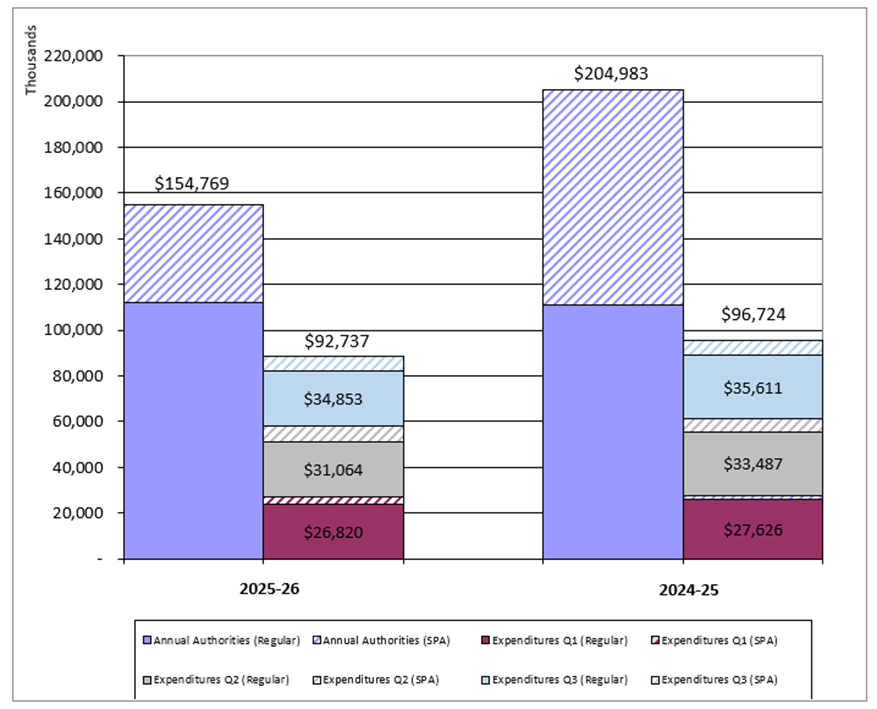
Graph 1 presents current and prior fiscal year expenditures compared to annual authorities at the end of the third quarter. These results are discussed in the section below.
Description of the image
At the end of the third quarter of 2025-26, authorities totalled $154,769 thousand compared to $204,983 thousand at the end of the same quarter of 2024-25.
At the end of the third quarter of 2025-26, expenditures totalled $92,737 thousand compared to $96,724 thousand at the end of the same quarter of 2024-25.
Third-quarter Expenditures
As illustrated in Graph 1, total expenditures for the third quarter decreased by $758 thousand (-2%), from $35,611 thousand in the same period of the previous fiscal year to $34,853 thousand in 2025-26.
Total third-quarter expenditures include both SPA and non-SPA components, with the following variances: non-SPA-related expenditures for the third quarter decreased by 3% from $29,242 thousand to $28,231 thousand while SPA-related expenditures increased by 4% from $6,369 thousand to $6,622 thousand. Overall, 60% of the total yearly authorities available for use were expended by the third quarter of 2025-26.
Significant variances2 in expenditures are explained as follows:
Personnel
The year-to-date expenditures related to personnel decreased by $3,571 thousand (-5%) compared to the same period of the previous fiscal year, from $71,770 thousand to $68,199 thousand. The decrease in salaries is due to a decrease in full-time equivalent (FTEs) from 2024-25 to 2025-26, which reflects staff reduction, including the release of terms and workforce adjustment implemented in 2024-25 to operate within reduced operating budget to CAS to deliver core Court operations.
Transportation and communications
The year-to-date expenditures related to transportation and communications services decreased by $526 thousand (-25%) compared to the same period of the previous fiscal year, from $2,113 thousand to $1,587 thousand. This decrease is mainly due to a decrease in telecommunication, relocation and travel expenses. CAS is continuing to phase out landlines to reduce telecommunication costs. In a similar effort, CAS has reduced discretionary spending, including travel.
Rentals
The year-to-date expenditures related to rentals decreased by $709 thousand (-14%) compared to the same period of the previous fiscal year, from $4,934 thousand to $4,225 thousand. This is mainly due to reduced annual software licenses renewals and maintenance fees, along with timing difference in the processing of software invoices compared to the prior year.
Acquisition of land, buildings and works
The year-to-date expenditures related to acquisition of land, buildings and works increased by $1,391 thousand (1023%) compared to the same period of the previous fiscal year, from $136 thousand to $1,527 thousand. This is mainly due to the timing of leasehold improvement projects, such as the national courts facilities modernization projects, for which costs can vary from year to year depending on project stage and progress.
Other expenditures
Other non-personnel year-to-date expenditures decreased by $566 thousand (-3%), from $17,771 thousand in the previous fiscal year to $17,205 thousand in the current year. This decrease is primarily attributable to lower spending on printing services (under Information), reduced purchases of stationery and office supplies, court apparel and printed materials (under Utilities, materials and supplies), and lower acquisitions of computer, video, and communications equipment and application software (under Acquisition of machinery and equipment). The decrease also reflects timing differences in processing invoices for repair and maintenance and various business services, such as engineering and architecture services, interpretation and translation services and informatic services.
Risks and Uncertainties
Workforce
Increasing workloads, combined with the potential for early staff departures within the current organizational culture and financial context, pose a risk of skill shortages and reduced capacity to deliver CAS’s mandate. These pressures may result in a loss of corporate knowledge and decreased productivity. In the broader context of workforce reductions across the federal public service, limited opportunities for employee development and career progression may further affect morale, engagement, and overall performance.
CAS is mitigating this risk by strengthening its workplace culture, supporting its workforce, and proactively addressing organizational risks, capacity pressures and skills gaps to ensure sustained operational readiness.
Financial resources
There is a significant risk that constrained financial resources will impede CAS’s ability to sustain core court operations and maintain acceptable service levels. Persistent long-term structural funding gaps stemming from chronic underfunding impact CAS’s ability to provide necessary court operations and services to the judiciary, litigants and Canadians. Without sufficient sustainable resources, CAS faces growing pressure on court operations, increased delays and backlogs in registry and judicial services, including file processing and scheduling and reduced capacity to support essential modernization initiatives.
In 2024-25, CAS reallocated $4 million from the NCFMP Special Purpose Allotment (SPA) to address critical pressures in its regular operations. This temporary measure enabled CAS to address the most immediate and critical operational risks without new funding or additional authorities; however, these funds must be reimbursed to the SPA in 2028-29. While this reallocation addressed urgent needs, residual risks and vulnerabilities remain and continue to affect CAS’s ability to deliver necessary administrative services to the Courts.
The risk is compounded by pressures related to official languages requirements. Although CAS received a three‑year temporary allocation in Budget 2024 to support obligations under the amended Official Languages Act (OLA), the funding represented only 25% of the initial request.
As a result, CAS does not currently have the resources required to manage both day‑to‑day translation, revision, and publication of court decisions and to address the backlog of approximately 1,900 decisions awaiting processing. When the temporary funding sunsets in March 2027, CAS will not have the financial capacity to sustain even current service levels. If unaddressed, the backlog is expected to grow by roughly 2,000 additional decisions per year, directly affecting Canadians’ ability to access judicial decisions in the official language of their choice and contributing to a rise in complaints to the Commissioner of Official Languages, which have already more than doubled since 2023.
To mitigate these risks, CAS has already implemented several key measures, including optimizing organizational structures, identifying efficiencies, streamlining business processes, and reallocating resources toward the highest‑risk areas. CAS has also leveraged digital tools and AI‑enabled capabilities to improve productivity, reduce manual workloads, and enhance efficiency in functions such as the translation and publication of court decisions. In addition, CAS has strengthened its financial oversight and monitoring mechanisms to enable earlier detection of pressures and more agile financial management.
Looking forward, CAS is advancing additional measures to address persistent structural funding gaps and strengthen long‑term financial sustainability. These include implementing a multi‑year funding strategy designed to proactively address ongoing financial pressures and support a sustainable long‑term financial framework. CAS is also enhancing integrated planning and resource alignment to ensure that financial, operational, and workforce planning are more coordinated and responsive to priority court operations. Moreover, CAS is collaborating closely with central agencies to secure ongoing, multi‑year sustainable funding that supports core court operations, statutory obligations under the OLA, and long‑term operational pressures.
Taken together, these measures aim to strengthen CAS’s financial resilience; however, enduring structural gaps will continue to constrain CAS’s ability to meet its mandate without a sustained increase in permanent funding.
Guard against, manage through, and recover from system disruptions
There is a risk that the organization will not have the appropriate organizational readiness to effectively guard against, manage through, and recover from system disruptions. Insufficient resilience or preparedness could result in interruptions to court operations, loss or compromise of critical data, financial impacts, reputational damage and inability to meet legislative obligations. This risk is heightened by aging technology, evolving cyber threats, and the increasing operational dependency on digital systems for court proceedings and registry services.
Within existing limited funding, CAS is mitigating this risk by strengthening its operational contingency and business continuity frameworks. This includes clarifying roles and responsibilities across the organization, integrating lessons learned from previous disruptions, and conducting more regular tabletop exercises to improve coordination, response, and recovery capacity. CAS is also advancing key modernization initiatives, such as enhancing monitoring of cyber risks, decommissioning or replacing legacy court systems and improving overall system and digital infrastructure security and stability. These measures collectively improve CAS’s readiness to respond to and recover from disruptions.
However, without additional investment in modern and resilient technologies, strengthened cybersecurity capabilities, and enhanced continuity-of-operations infrastructure, CAS will not be able to fully mitigate this risk or meet the increasing operational demands placed on its systems.
Information for decision-making
There is a risk that authoritative, timely, and reliable information required for decision-making will not be available to the organization. This risk is driven by inaccessible, fragmented, and poorly integrated data that limits the organization’s ability to produce meaningful business intelligence to support operational, financial, and strategic decisions. Reliance on manual data management processes further exacerbates the challenge: these processes are time‑consuming, prone to human error, and reduce the accuracy, consistency, and quality of information needed to respond to emerging priorities and manage organizational performance.
Within existing limited funding, CAS is partially mitigating this risk by improving monitoring and reporting tools, establishing clear performance baselines, and implementing policies that strengthen data governance, stewardship, security, and compliance. Additionally, CAS is enhancing data management through stronger stewardship roles, data-literacy initiatives, and the development of security and information-management standards aimed at reducing operational, privacy, and information-handling risks.
However, without additional investment, CAS will not be positioned to fully mitigate this risk or to establish the modern data infrastructure, integrated systems, and enterprise‑level governance required to support authoritative information and evidence‑based decision‑making across the organization or for the Courts. Sustainable progress will require further modernization of data systems, tools, and processes to ensure that decision makers at all levels and the Courts have access to accurate and reliable information when they need it.
Significant changes in relation to operations, personnel and programs
Several changes have occurred within the executive management team since the last quarterly financial report:
- David Boudreau was appointed Acting Deputy Chief Administrator, Judicial and Registry Services, on October 20, 2025, following the retirement of Wayne Lepine.
- Sébastien Delisle-Côté was appointed Chief Digital Officer on November 20, 2025.
Approval by Senior Officials
Approved by:
Original signed by
Darlene H. Carreau, LL.B
Chief Administrator
and Chief Executive Officer
Original signed by
Paul Mokha, CPA, MBA
Acting Assistant Deputy Minister,
Corporate Services Sector,
Chief Financial Officer &
Chief Security Officer
(Ottawa, Canada)
(February 27, 2026)
| Fiscal year 2025-26 | Fiscal year 2024-25 | |||||
|---|---|---|---|---|---|---|
| Total available for use for the year ending March 31, 2026i | Used during the quarter ended December 31, 2025 | Year-to-date used at quarter-end | Total available for use for the year ending March 31, 2025 | Used during the quarter ended December 31, 2024 | Year-to-date used at quarter-end | |
| Vote 1 – Operating expenditures | $142,678 | $32,099 | $84,474 | $194,522 | $32,771 | $88,879 |
| Statutory authorities: | ||||||
| Contributions to employee benefit plans | 12,091 | 2,754 | 8,263 | 10,461 | 2,840 | 7,845 |
| Spending of proceeds from the disposal of surplus Crown assets | - | - | - | - | - | - |
| Refunds of amounts credited to revenues in previous years | - | - | - | - | - | - |
| Total budgetary authorities | $154,769 | $34,853 | $92,737 | $204,983 | $35,611 | $96,724 |
| i Includes only authorities available for use and granted by Parliament at quarter-end. | ||||||
| Expenditures: | Fiscal year 2025-26 | Fiscal year 2024-25 | ||||
|---|---|---|---|---|---|---|
| Planned expenditures for the year ending March 31, 2026 | Expended during the quarter ended December 31, 2025 | Year-to-date used at quarter-end | Planned expenditures for the year ending March 31, 2025 | Expended during the quarter ended December 31, 2024 | Year-to-date used at quarter-end | |
| Personnel | $90,641 | $23,422 | $68,199 | $89,470 | $26,985 | $71,770 |
| Transportation and communications | 2,750 | 538 | 1,587 | 3,379 | 549 | 2,113 |
| Information | 635 | 415 | 660 | 950 | 66 | 695 |
| Professional and special services | 28,630 | 6,333 | 13,742 | 61,807 | 5,118 | 13,587 |
| Rentals | 4,068 | 1,386 | 4,225 | 7,400 | 1,417 | 4,934 |
| Repair and maintenance | 1,342 | 62 | 257 | 900 | 437 | 631 |
| Utilities, materials and supplies | 2,191 | 588 | 1,497 | 2,904 | 496 | 1,689 |
| Acquisition of land, building and works | 14,513 | 1,376 | 1,527 | 26,677 | 110 | 136 |
| Acquisition of machinery and equipment | 9,996 | 732 | 1,038 | 11,494 | 429 | 1,164 |
| Other subsidies and payments | 3 | 1 | 5 | 2 | 4 | 5 |
| Total budgetary expenditures | $154,769 | $34,853 | $92,737 | $204,983 | $35,611 | $96,724 |
Groupings can change between quarters due to materiality of initiatives.
Amounts may differ with other public documents due to rounding.
1 Special purpose allotments (SPA) are used to restrict the use of funds to specific programs or initiatives.
2 Significant variances are defined as variances by standard object that are greater than $250 thousand or 25%.
- Date modified: