
Quarterly Financial Report - For the quarter ended September 30, 2025
Statement outlining results, risks and significant changes in operations, personnel and programs
Introduction
This quarterly report should be read in conjunction with the Main Estimates. It has been prepared by management as required by section 65.1 of the Financial Administration Act and in the form and manner prescribed by Treasury Board. This quarterly report has not been subject to an external audit or review.
The role of the Courts Administration Service (CAS) is to provide administrative services to four superior courts of law: the Federal Court of Appeal, the Federal Court, the Court Martial Appeal Court of Canada and the Tax Court of Canada. Further details on CAS’ programs can be found in the 2025-26 Main Estimates.
Basis of Presentation
This quarterly report has been prepared by management using an expenditure basis of accounting. The accompanying Statement of Authorities includes CAS’ spending authorities granted by Parliament and those used by the organization as of the end of this quarter. This quarterly report has been prepared using a prescribed financial reporting framework designed to meet financial information needs with respect to the use of spending authorities.
The authority of Parliament is required before monies can be spent by the Government. Approvals are given in the form of annually approved limits through appropriation acts or legislation in the form of statutory spending authority for specific purposes.
CAS uses the full accrual method of accounting to prepare and present its annual departmental financial statements that are part of the departmental results reporting process. However, the spending authorities voted by Parliament remain on an expenditure basis.
Highlights of fiscal quarter and fiscal year-to-date (YTD) Results
Significant Changes to the total Authorities for the fiscal year
As illustrated in the Statement of Authorities and the Departmental Budgetary Expenditures by Standard Object tables at the end of this report, yearly total authorities as of September 30, 2025, increased by $19,360 thousand (9.8%) compared to the same quarter in 2024-25, from $196,556 thousand to $215,916 thousand.
As of 2023-24, CAS annual authorities include a significant portion of Special Purpose Allotments funding (SPA)1, 49% in 2025-26 ($106,304 thousand out of a total of $215,916 thousand) due to the multi-year funding for projects under the National Courts Facilities Modernization Program (NCFMP). Total authorities for 2025-26 include an amount of $68.3 million in a frozen allotment, pending central agencies’ approval, to be re-profiled to future years to better align with projects delivery schedule under the courts’ facilities modernization program.
The increase in authorities is due to $17,735 thousand in additional funding in 2025-26 received for the National Courts Facilities Modernization Program, $2,658 thousand for Access to Justice in Both Official Languages, $1,223 thousand related to the signature of collective agreements for various groups (e.g. AS, LP, etc.) and $1,005 thousand in contributions to employee benefit plans.
The increase also includes $1,855 thousand to the regular operating budget carry-forward. The above increases are offset by $5,116 thousand of funding for Strengthen Service and Digital Capabilities to Modernize Canada’s Federal Courts (SSDC), which sunsetted in 2024-25.
As a result of the Government expenditure management cycle and certain conditions imposed by Central Agencies, there are often significant fluctuations by quarter between authorities received and the timing of expenditures realized.
Significant Changes to Expenditures
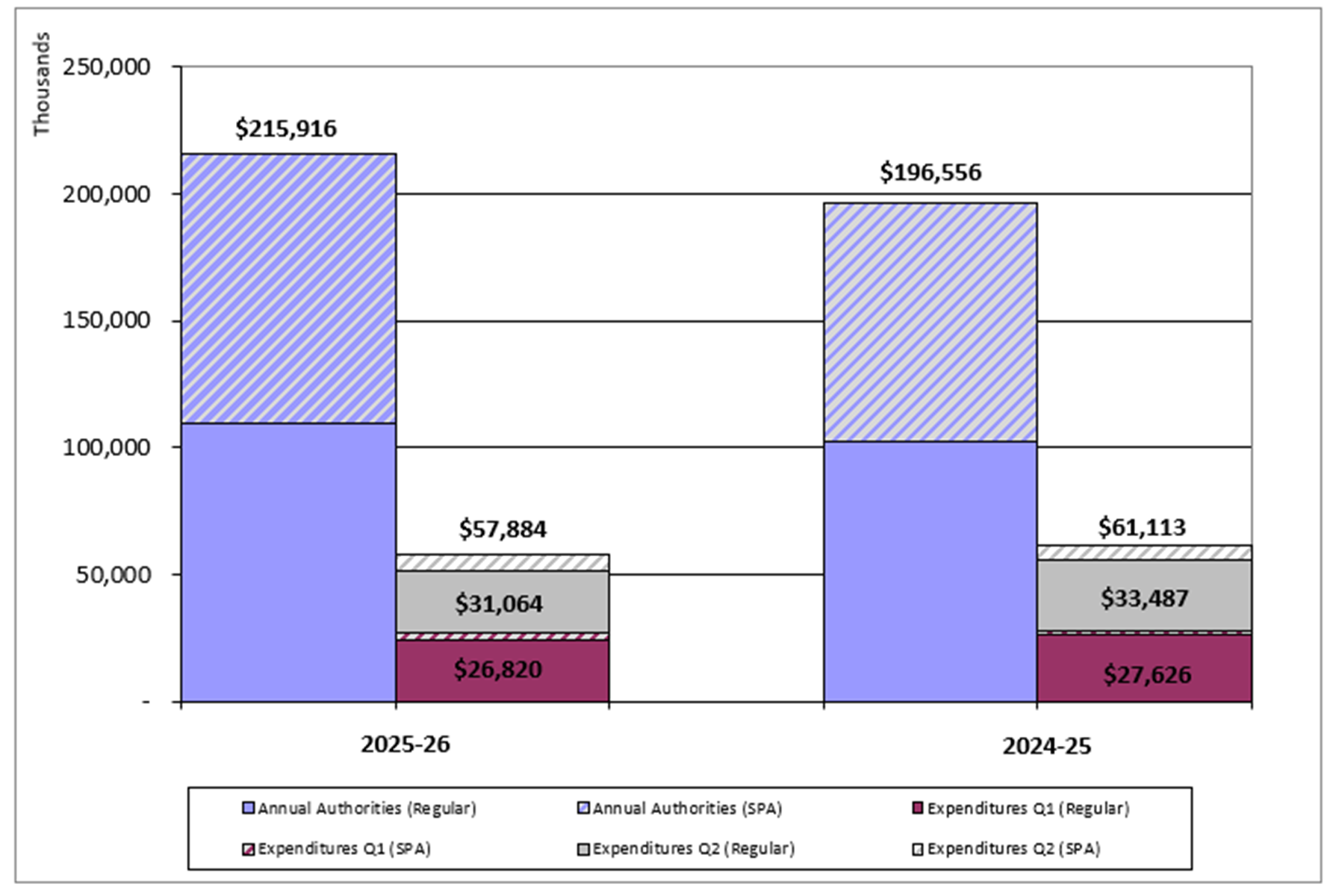
Graph 1 presents current and prior fiscal year expenditures compared to annual authorities at the end of the second quarter. These results are discussed in the section below.
Description of the image
At the end of the second quarter of 2025-26, authorities totalled $215,916 thousand compared to $196,556 thousand at the end of the same quarter of 2024-25.
At the end of the second quarter of 2025-26, expenditures totalled $57,884 thousand compared to $61,113 thousand at the end of the same quarter of 2024-25.
Second-quarter Expenditures
As illustrated in Graph 1, total expenditures for the second quarter decreased by $2,423 thousand (-7%), from $33,487 thousand in the same period of the previous fiscal year to $31,064 thousand in 2025-26. This decrease is mostly attributable to lower non-SPA-related expenditures, as outlined in the explanation of significant variances below.
Non-SPA-related expenditures for the second quarter decreased by 12% from $27,860 thousand to $24,513 thousand while SPA-related expenditures increased by 16% from $5,627 thousand to $6,551 thousand. Overall, 27% of the total yearly authorities available for use were expended by the second quarter of 2025-26.
Significant variances2 in expenditures are explained as follows:
Transportation and communications
The year-to-date expenditures related to transportation and communications services decreased by $515 thousand (-33%) compared to the same period of the previous fiscal year, from $1,564 thousand to $1,049 thousand. This decrease is mainly due to a decrease in telecommunication, relocation and travel expenses. CAS is continuing to phase out landlines to help lower telecommunication costs. In a similar effort to manage discretionary spending, CAS has also scaled back travel budgets.
Professional and special services
The year-to-date expenditures related to professional and special services decreased by $1,061 thousand (-13%) compared to the same period of the previous fiscal year, from $8,468 thousand to $7,104 thousand. This is mainly due to a decrease in interpretation and translation services, and other business services. CAS has reduced translation costs while building internal capacity to provide these services internally. The decrease is partially offset by an increase in engineering and architectural services to support the new Montreal Judicial Complex and Toronto construction projects under the National Courts Facilities Modernization Program.
Rentals
The year-to-date expenditures related to rentals decreased by $678 thousand (-19%) compared to the same period of the previous fiscal year, from $3,517 thousand to $2,839 thousand. This is mainly due to a decrease in renewal fees of annual software licenses and maintenance fees as well as timing difference in processing of invoices for office buildings rental between quarters in the prior year.
Other expenditures
Other non-salary year-to-date expenditures decreased by $964 thousand (-35%), from $2,779 thousand in the previous fiscal year to $1,815 thousand in the current year. This decrease is primarily attributable to lower spending on printing services (under Information), reduced purchases of stationery and office supplies, court apparel and printed materials (under Utilities, materials and supplies), and lower acquisitions of computer, video, and communications equipment and application software (under Acquisition of machinery and equipment). The decrease also reflects timing differences in processing invoices for electronic subscriptions.
Conversely, expenditures related to the acquisition of land, buildings and works increased by $125 thousand due to the timing of leasehold improvement projects, for which costs can vary from year to year depending on project stage and progress.
Risks and Uncertainties
CAS continues to experience financial risks and vulnerabilities. In addition, CAS had to absorb sunsetted funding to support the asylum caseload. These pressures were partially mitigated through a temporary internal reallocation of SPA funding and realigning resources with priorities. In 2024-25, CAS reallocated $4 million from SPA funding to address financial pressures in its regular operations. This amount will be reimbursed to the National Court Facilities Modernisation Program SPA in 2028-29. This reallocation enabled CAS to address the most immediate and critical risks and pressures without requiring new funding or additional authorities. However, while some deficiencies have been addressed, residual risks and vulnerabilities remain and will affect CAS’s future ability to provide necessary administrative services to the judiciary. For example:
- Most non-personnel expenses incurred by CAS are non-discretionary and directly support the judicial process, including court hearings and security. These expenses cover services such as translation, protection, informatic equipment such as video conference hardware and software, court reporting, transcription services, and similar operational costs. They are largely driven by the volume, type, and duration of hearings conducted each year—factors that are beyond CAS’s control and significantly limit the organization's financial flexibility.
- Amendments to the Official Languages Act came into force in June 2024, requiring CAS to release in both official languages simultaneously decisions of precedential value, in addition to cases that raise questions of law of general public interest or national importance. The impact on CAS’ operations is very significant and resource intensive. CAS does not have the appropriate level of resources to meet these new legislative requirements. The temporary funding is set to sunset at the end of March 2027 which will result in further delays and backlogs in the publication of Federal Courts decisions in both official languages, thereby impeding access to justice for Canadians.
- Cybersecurity is an on-going threat for any organization. As such CAS continues to modernize IT systems to adapt to evolving needs and sustain operational resilience.
- CAS is also experiencing increased costs, case complexity and volume, reducing CAS's ability to meet its obligations and capacity to optimize its processes and operations.
- In August 2025, CAS submitted a request to central agencies to reprofile a total of $131.4 million in funding for the NCFMP, originally allocated for fiscal years 2024–25 and 2025–26, to future years. This adjustment aims to better align funding with the revised project delivery schedule. As of now, the request remains pending approval, posing a financial risk to the department, particularly the $63 million earmarked for 2024–25. If the request is not approved, it could significantly impact the delivery and completion of key facilities modernization projects.
CAS continues to address financial pressures by implementing a range of mitigation strategies. These include establishing baseline and multi-year budgets, optimizing and strengthening organizational structures, enhancing integrated planning, regularly reassessing and realigning resources with priorities and identifying efficiencies.
Significant changes in relation to operations, personnel and programs
There has been a change to the executive management team since July 1, 2025:
- Paul Mokha was appointed acting Assistant Deputy Minister of Corporate Services and Chief Financial Officer on July 17, 2025.
Approval by Senior Officials
Approved by:
Original signed by
Darlene H. Carreau, LL.B
Chief Administrator
and Chief Executive Officer
Original signed by
Paul Mokha, CPA, MBA
Acting Assistant Deputy Minister,
Corporate Services Sector,
Chief Financial Officer &
Chief Security Officer
(Ottawa, Canada)
(November 28, 2025)
| Fiscal year 2025-26 | Fiscal year 2024-25 | |||||
|---|---|---|---|---|---|---|
| Total available for use for the year ending March 31, 20263 | Used during the quarter ended September 30, 2025 | Year to date used at quarter-end | Total available for use for the year ending March 31, 202513 | Used during the quarter ended September 30, 2024 | Year to date used at quarter-end | |
| Vote 1 – Operating expenditures | $204,899 | $28,310 | $52,376 | $186,361 | $30,911 | $56,016 |
| Statutory authorities: | ||||||
| Contributions to employee benefit plans | 11,017 | 2,754 | 5,508 | 10,195 | 2,576 | 5,097 |
| Spending of proceeds from the disposal of surplus Crown assets | - | - | - | - | - | - |
| Refunds of amounts credited to revenues in previous years | - | - | - | - | - | - |
| Total budgetary authorities | $215,916 | $31,064 | $57,884 | $196,556 | $33,487 | $61,113 |
| Expenditures: | Fiscal year 2025-26 | Fiscal year 2024-25 | ||||
|---|---|---|---|---|---|---|
| Planned expenditures for the year ending March 31, 2026 | Expended during the quarter ended September 30, 2025 | Year to date used at quarter-end | Planned expenditures for the year ending March 31, 2025 | Expended during the quarter ended September 30, 2024 | Year to date used at quarter-end | |
| Personnel | $84,613 | $22,915 | $44,774 | $85,215 | $23,769 | $44,785 |
| Transportation and communications | 2,705 | 574 | 1,049 | 3,183 | 846 | 1,564 |
| Information | 635 | 71 | 245 | 528 | 356 | 629 |
| Professional and special services | 62,043 | 5,276 | 7,407 | 59,487 | 5,264 | 8,468 |
| Rentals | 6,557 | 1,375 | 2,839 | 6,082 | 2,115 | 3,517 |
| Repair and maintenance | 1,338 | 30 | 195 | 641 | 76 | 195 |
| Utilities, materials and supplies | 2,191 | 578 | 914 | 2,729 | 470 | 1,193 |
| Acquisition of land, building and works | 39,101 | 142 | 151 | 27,123 | 26 | 26 |
| Acquisition of machinery and equipment | 16,730 | 102 | 306 | 11,546 | 564 | 735 |
| Other subsidies and payments | 3 | 1 | 4 | 22 | 1 | 1 |
| Total budgetary expenditures | $215,916 | $31,064 | $57,884 | $196,556 | $33,487 | $61,113 |
Groupings can change between quarters due to materiality of initiatives.
Amounts may not balance with other public documents due to rounding..
1 Special purpose allotments (SPA) are used to restrict the use of funds to specific programs or initiatives.
2 Significant variances are defined as variances by standard object that are greater than $500 thousand.
3 - Includes only authorities available for use and granted by Parliament at quarter-end.
- Date modified: