
Quarterly Financial Report - For the quarter ended June 30, 2026
STATEMENT OUTLINING RESULTS, RISKS AND SIGNIFICANT CHANGES IN OPERATIONS, PERSONNEL AND PROGRAMS
Introduction
This quarterly report should be read in conjunction with the Main Estimates. It has been prepared by management as required by section 65.1 of the Financial Administration Act and in the form and manner prescribed by Treasury Board. This quarterly report has not been subject to an external audit or review.
The role of the Courts Administration Service (CAS) is to provide administrative services to four superior courts of law: the Federal Court of Appeal, the Federal Court, the Court Martial Appeal Court of Canada and the Tax Court of Canada. Further details on CAS’s programs can be found in the 2026-27 Main Estimates.
Basis of Presentation
This quarterly report has been prepared by management using an expenditure basis of accounting. The accompanying Statement of Authorities includes CAS’ spending authorities granted by Parliament and those used by the organization consistent with the 2026-27 Main Estimates. This quarterly report has been prepared using a prescribed financial reporting framework designed to meet financial information needs with respect to the use of spending authorities.
The authority of Parliament is required before monies can be spent by the Government. Approvals are given in the form of annually approved limits through appropriation acts or legislation in the form of statutory spending authority for specific purposes.
CAS uses the full accrual method of accounting to prepare and present its annual departmental financial statements that are part of the departmental results reporting process. However, the spending authorities voted by Parliament remain on an expenditure basis.
Highlights of fiscal quarter and fiscal year-to-date (YTD) Results
Significant changes to the total authorities available for use for the fiscal year
As illustrated in the Statements of Authorities and the Departmental Budgetary Expenditures by Standard Object tables at the end of this report, yearly authorities available for use as of June 30, 2026, decreased by $19,999 thousand (9.6%) compared to the same quarter in 2025-26, from $208,741 thousand to $188,742 thousand.
The decrease in authorities is primarily attributable to a $20,461 thousand reduction in funding allocation for the National Courts Facilities Modernization Program and a $47 thousand transfer to the Royal Canadian Mounted Police (RCMP) for law enforcement record checks. This net decrease is partially offset by targeted increases totaling $509 thousand, comprising $143 thousand in contributions to employee benefit plans, $272 thousand in collective bargaining adjustments, and $94 thousand in other adjustments required to support the establishment of new Superior Court appointments.
Starting in 2023-24, CAS annual authorities include a significant portion of Special Purpose Allotments funding (SPA)1, 43% in 2026-27 ($81,419 thousand out of a total of $188,742 thousand) due to the multi-year funding for projects under the National Courts Facilities Modernization Program.
As a result of the Government expenditure management cycle and certain conditions imposed by Central Agencies, there are often significant fluctuations by quarter between authorities received and the timing of expenditures realized.
Significant Changes to Expenditures
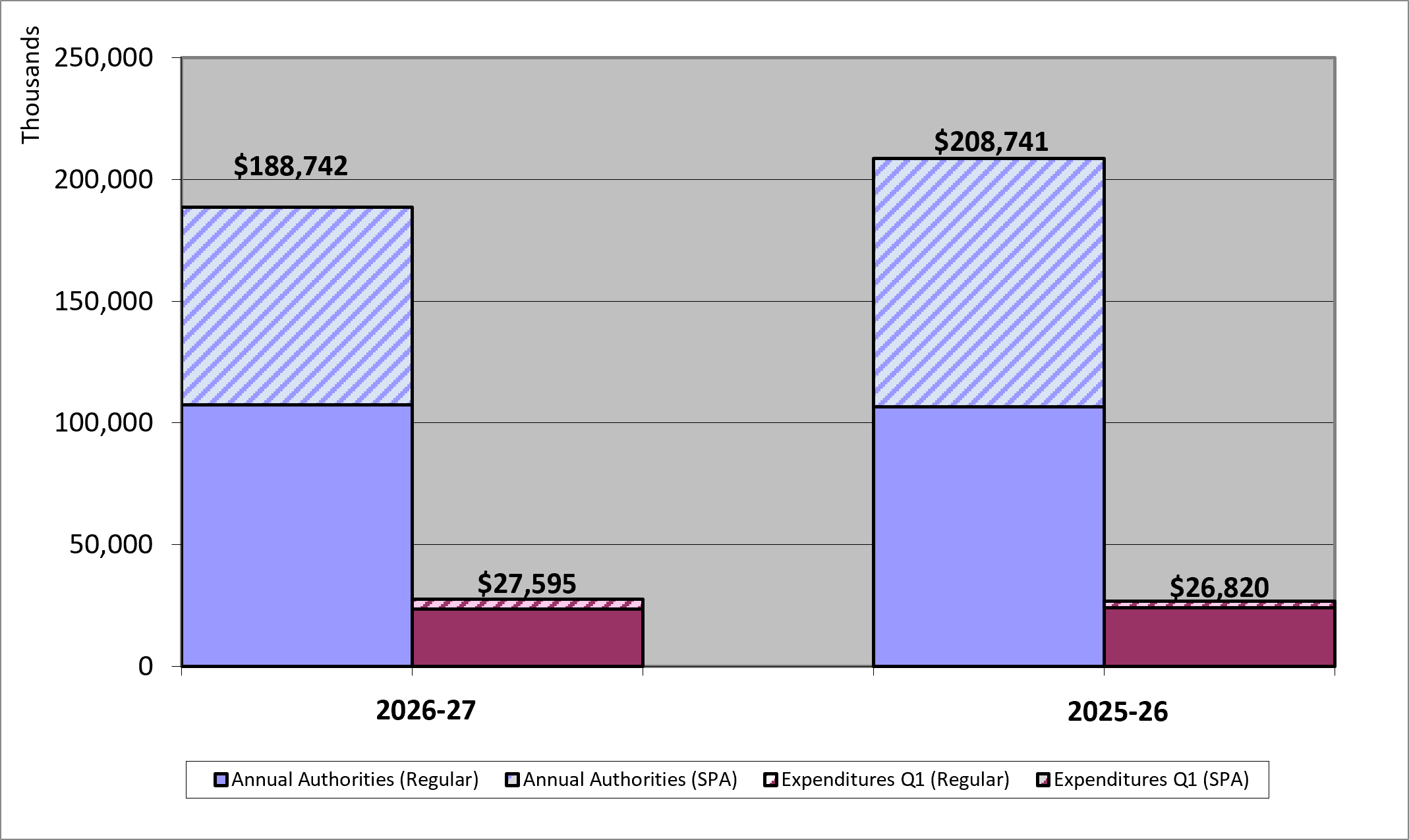
Figure 1 presents current and prior fiscal year expenditures compared to annual authorities at the end of the first quarter. These results are discussed in the section below.
Description of the image
At the end of the first quarter of 2026-27, authorities totalled $188,742 thousand compared to $208,741 thousand at the end of the same quarter of 2025-26.
At the end of the first quarter of 2026-27, expenditures totalled $27,595 thousand compared to $26,820 thousand at the end of the same quarter of 2025-26.
First-quarter Expenditures
As illustrated in Figure 1, first-quarter expenditures increased by $775 thousand (3%) compared to the same period of the previous fiscal year, from $26,820 thousand to $27,595 thousand. As a result, 15% of the yearly authorities available for use were expended during the first quarter of 2026-27, which represents an increase of 2% compared to the same quarter of 2025-26.
Significant variances2 in expenditures are explained as follows:
Personnel
The year-to-date expenditures related to personnel increased by $829 thousand (4%) compared to the same period of the previous fiscal year, from $21,860 thousand to $22,689 thousand. This increase is mainly due to higher salary rates and wages resulting from collective agreements signed in 2023-24, as well as higher employer contributions to employee benefits.
Professional and special services
Year-to-date expenditures for professional and special services increased by $711 thousand (33%) compared with the same period in the previous fiscal year, rising from $2,133 thousand to $2,844 thousand. The increase was mainly due to higher costs for engineering and architectural services, interpretation services, and other business services. Engineering and architectural services rose by $289 thousand, reflecting project costs under the National Courts Facilities Modernization Program for the Kent, Sparks and Oakville locations.
Interpretation and translation services increased by $156 thousand, business services by $177 thousand, protection services by $95 thousand, and informatics services by $60 thousand, largely due to the timing of prior-year invoices. These increases were partially offset by a $122 thousand decrease in other services, mainly reflecting differences in the timing of invoice receipt compared with the same period of the previous fiscal year. The remaining variance reflects minor increases totaling $56 thousand across legal services, training and educational services, management consulting, special fees and services, and health and welfare services.
Rentals
The year-to-date expenditures related to rentals decreased by $557 thousand (38%) compared to the same period of the previous fiscal year, from $1,464 thousand to $907 thousand. This decrease is mainly due to timing differences: delayed building rental invoices from lessors and pending renewals of IT software licenses and maintenance agreements, which temporarily reduced current-period charges compared to the previous period.
Other expenditures
While remaining expenditures have also decreased compared to the same period of the previous fiscal year; the variations are considered immaterial. The decrease is primarily attributable to lower spending on freight and postage, repair and maintenance of machinery and equipment, and timing differences in processing invoices.
Risks and Uncertainties
CAS faces several interrelated risks that could affect its ability to deliver timely, effective, and accessible court services. While the recent approval of funding for the Digital Courts Modernization Project – Implementation Phase 1 (Case Management System) will help mitigate several operational, workforce, and technology-related challenges, the risks outlined below represent the residual risks that remain and will continue to require active engagement and management.
Financial Resources
Financial pressures are the most significant residual risk facing CAS. Chronic funding gaps are straining core court operations, contributing to service delays, growing backlogs, and limited capacity to support modernization efforts.
In particular, CAS continues to face significant pressures arising from sustained growth in immigration and refugee-related litigation before the Federal Court. Case volumes have reached historic levels and are expected to increase further as a result of recent legislative and policy changes. While CAS continues to implement operational efficiencies and modernization initiatives, the growing demand for registry, judicial support, and case management services creates ongoing and critical financial pressures and heightens the risk of delays in the administration of justice.
Another concern is the backlog of court decisions requiring translation and publication under official languages requirements, which is expected to worsen without sustained funding despite ongoing efficiency measures, temporary funding support, and the investments being made through digital modernization. Although CAS received a three-year temporary allocation in Budget 2024 to address years of chronic underfunding and support obligations under the amended Official Languages Act (OLA), the funding represented only 25% of the initial request. As a result, CAS does not currently have the resources required to manage both day-to-day translation, revision, and publication of court decisions and to address the backlog of approximately 1,900 decisions awaiting processing. When the temporary funding sunsets in March 2027, CAS will not have the financial capacity to sustain even current service levels. If unaddressed, the backlog is expected to grow by roughly 2000 additional decisions per year, directly affecting Canadians’ ability to access judicial decisions in the official language of their choice and contributing to a rise in complaints to the Commissioner of Official Languages, which have already more than doubled since 2023.
In 2024-25, CAS reallocated $4 million from the NCFMP Special Purpose Allotment (SPA) to address critical pressures in its regular operations. This temporary measure enabled CAS to address the most immediate and critical operational risks without new funding or additional authorities; however, these funds must be reimbursed to the SPA in 2028-29. While this reallocation addressed urgent needs, residual risks and vulnerabilities remain and continue to affect CAS’s ability to deliver necessary administrative services to the Courts. In addition, CAS has strengthened its financial oversight and monitoring mechanisms to enable earlier detection of pressures and more agile financial management.
Workforce
Workforce capacity is also under pressure due to increasing workloads, potential staff departures, and limited career development opportunities. These challenges could lead to skill shortages, loss of corporate knowledge, lower productivity, and reduced ability to deliver services effectively. To address this, CAS is strengthening workforce planning, supporting employee development, and building specialized digital expertise.
Operational Resilience
Operational resilience and access to reliable information remain important longer-term residual risks. Aging technology, evolving cyber threats, fragmented data systems, and reliance on manual processes increase the risk of service disruptions and limit evidence-based decision-making. In addition, aging physical and digital infrastructure present growing challenges to operational continuity and security. The current data centre environment includes aging server infrastructure and limited backup and cooling capacity, increasing the risk of service interruptions, cybersecurity incidents, and prolonged recovery times. CAS also faces increasing pressures to support a growing number of sensitive and classified proceedings, including national security matters, which require secure facilities and information-handling environments that meet increasingly stringent security requirements.
CAS is mitigating this risk by strengthening its operational contingency and business continuity frameworks. This includes clarifying roles and responsibilities across the organization, integrating lessons learned from previous disruptions, and conducting more regular tabletop exercises to improve coordination, response, and recovery capacity. CAS is also partially mitigating this risk by improving monitoring and reporting tools, establishing clear performance baselines, and implementing policies that strengthen data governance, stewardship, security, and compliance. Although CAS is improving business continuity planning, cybersecurity, data governance, and digital infrastructure, including implementing a new case management system, additional long-term investment will be needed to fully address these vulnerabilities and support evolving operational demands.
Significant changes in relation to operations, personnel and programs
Below are the changes that have occurred within the executive management team since the last quarterly financial report:
- David Boudreau was reappointed Acting Chief Administrator on March 22, 2026.
- Martin Beliveau also continues his acting appointment as Deputy Chief Administrator, Judicial and Registry Services since March 22, 2026.
Approval by Senior Officials
Approved by:
Original signed by
David Boudreau
A/Chief Administrator
and Chief Executive Officer
Original signed by
Paul Mokha, CPA, MBA
Acting Assistant Deputy Minister,
Corporate Services Sector,
Chief Financial Officer &
Chief Security Officer
(Ottawa, Canada)
(August 28, 2026)
| Fiscal year 2026-27 | Fiscal year 2025-26 | |||||
|---|---|---|---|---|---|---|
| Total available for use for the year ending March 31, 2027i | Used during the quarter ended June 30, 2026 | Year-to-date used at quarter-end | Total available for use for the year ending March 31, 2026i | Used during the quarter ended June 30, 2025 | Year-to-date used at quarter-end | |
| Vote 1 – Operating expenditures | $177,105 | $24,686 | $24,686 | $197,724 | $24,066 | $24,066 |
| Statutory authorities: | ||||||
| Contributions to employee benefit plans | 11,637 | 2,909 | 2,909 | 11,017 | 2,754 | 2,754 |
| Spending of proceeds from the disposal of surplus Crown assets | - | - | - | - | - | - |
| Refunds of amounts credited to revenues in previous years | - | - | - | - | - | - |
| Total budgetary authorities | $188,742 | $27,595 | $27,595 | $208,741 | $26,820 | $26,820 |
| i Includes only authorities available for use and granted by Parliament at quarter-end. | ||||||
| Expenditures: | Fiscal year 2026-27 | Fiscal year 2025-26 | ||||
|---|---|---|---|---|---|---|
| Planned expenditures for the year ending March 31, 2027 | Expended during the quarter ended June 30, 2026 | Year-to-date used at quarter-end | Planned expenditures for the year ending March 31, 2026 | Expended during the quarter ended June 30, 2025 | Year-to-date used at quarter-end | |
| Personnel | $85,491 | $22,689 | $22,689 | $83,023 | $21,860 | $21,860 |
| Transportation and communications | 2,540 | 312 | 312 | 2,590 | 474 | 474 |
| Information | 609 | 140 | 140 | 608 | 174 | 174 |
| Professional and special services | 48,249 | 2,844 | 2,844 | 59,404 | 2,133 | 2,133 |
| Rentals | 5,298 | 907 | 907 | 6,278 | 1,464 | 1,464 |
| Repair and maintenance | 1,281 | 166 | 166 | 1,281 | 165 | 165 |
| Utilities, materials and supplies | 2,098 | 407 | 407 | 2,098 | 337 | 337 |
| Acquisition of land, building and works | 29,675 | - | - | 37,438 | 9 | 9 |
| Acquisition of machinery and equipment | 13,498 | 100 | 100 | 16,018 | 204 | 204 |
| Other subsidies and payments | 3 | 30 | 30 | 3 | - | - |
| Total budgetary expenditures | $188,742 | $27,595 | $27,595 | $208,741 | $26,820 | $26,820 |
Groupings can change between quarters due to materiality of initiatives.
Amounts may differ with other public documents due to rounding.
1 Special purpose allotments (SPA) are used to restrict the use of funds to specific programs or initiatives.
2 Significant variances are defined as variances by standard object that are greater than $500 thousand.
- Date modified: