
Audit of Procurement of Low Dollar Value Professional Services
Table of Contents
Executive Summary
Procurement of Low Dollar Value Professional Services
This audit examined the procurement of professional services at the Courts Administration Service (CAS), with a focus on low dollar value (LDV) contracts. While procurement rules allow for awarding sole-source contracts that do not exceed $40,000, they emphasize the use of competitive processes. Even if it is permitted, awarding contracts without seeking multiple bids should not become standard practice. Doing so increases the risk of repeatedly giving contracts to the same vendor for similar services, which can compromise the fairness and transparency of the competitive process.
At CAS, LDV procurements account for most of the contracts awarded – approximately 84% of all professional service contracts annually. In 2023-24, 224 out of 267 contracts awarded were LDV, valued at approximately $2.2 million.
Objective of the audit. To determine if CAS’s procurement of LDV professional services was managed in a way that enables operational outcomes and demonstrates sound stewardship and value for money by complying with procurement rules.
Findings. Requirements were defined prior to awarding contracts and committing funds. Integrity and security checks were appropriate. Vendor performance was monitored and deliverables received. All files reviewed were authorized by personnel with proper delegated authorities.
Some non-compliance with procurement rules were identified, along with opportunities to enhance competition and efficiency. Areas for improvement include estimating costs before reaching out to vendors, obtaining multiple quotes, providing clear justification for the chosen procurement method, and sharing the procurement code of conduct with vendors. In some cases, work started prior to an official contract being in place, and amendments were not always properly managed. Weaknesses also existed in the record-keeping practices by business owners managing the contracts.
Many issues identified likely stem from the lack of up-to-date CAS-specific procurement guidance – one of the recommendations made by the Office of the Procurement Ombuds in 2018 that was implemented but not kept current over the years.
Conclusion
CAS’s procurement of LDV professional services, while enabling operational outcomes, struggles at times to demonstrate sound stewardship and value for money.
Recommendations.
- Strengthen oversight of procurement.
- Update the policy framework for contracting for legal services.
- Update CAS-specific guidance.
- Establish standard practices to document and manage procurement information.
Management accepted the recommendations and developed an action plan.
Background
Courts Administration Service
- Since its establishment in 2003, the Courts Administration Service (CAS) has been entrusted with providing effective and efficient judicial, registry, and corporate services to Canada’s four national Courts. In fulfilling this essential mandate, CAS plays a vital role in safeguarding judicial independence while enhancing accountability for the use of public funds.
- Judicial independence is enhanced by placing administrative services at arm’s length from the Government of Canada (GC) and by affirming the roles of chief justices and judges in the management of the Courts. CAS is in a unique position relative to the Courts and, in most cases, must follow GC legislation, regulations, policies and directives.
CAS is a unique organization
CAS is a federal government department that serves four independent national courts:
- Federal Court of Appeal (FCA)
- Federal Court (FC)
- Court Martial Appeal Court of Canada (CMACC)
- Tax Court of Canada (TCC)
Procurement of Professional Services
- The GC spends billions of dollars of public funds annually on the procurement of goods, services and construction. Professional services, which is a subset of procurement of services, support departments, including CAS, in delivering its programs and services. Professional services cover a wide array of services and are typically thought of as consultants; however, LDV professional services at CAS can include services such as consultants, interpretation, training, paper shredding, office cleaning, court ushers, and Commissionaires.
- Subject to certain exceptions, the process for government procurement must be open, fair, and transparent. To help achieve these objectives, the GC established a suite of instruments, including legislation, regulations, and polices. Strong governance and adherence to procurement rules help ensure services are delivered effectively, provide value for money, and sound stewardship of public funds.
- Procurement and its associated rules in the GC can be complex and involves various parties. Departments are accountable for their own procurement decisions, activities, and spending. Deputy heads are accountable for managing procurement, and senior designated officials for the management of procurement are responsible for supporting this accountability. Procurement roles, accountabilities, and responsibilities at CAS are described in Exhibit 1.
- For the past three fiscal years, CAS has spent over $10 million annually on professional services. In 2025-26, the organization plans to spend $9.4 million, or just over 40% of its operational and maintenance budget, on contracts for professional services.
- Recent failures in procurement across various government institutions have raised concerns about procurement practices for professional services across the GC. Increased scrutiny by Parliamentarians and external assurance providers, such as the Office of the Auditor General, and internal audit, such as the Office of the Comptroller General of Canada, has led to changes to the rules related to the procurement of professional services.
Exhibit 1: Procurement roles, accountabilities and responsibilities at CAS
| Roles | Accountabilities and responsibilities | Position at CAS |
|---|---|---|
| Deputy Head | Accountable for requirements under the Directive on the Management of Procurement. Deputy heads are responsible for designating a senior official to manage procurement. | Chief Administrator and Chief Executive Officer |
| Senior Designated Official for the management of procurement | Responsible for establishing, implementing, and maintaining the departmental procurement management framework, which includes processes, systems, and controls that support procurement activities in their department. | Assistant Deputy Minister (ADM), Corporate Services Sector, Chief Financial Officer (CFO) and Chief Security Officer (CSO) |
| Contracting Authority | Delegated authority to start a contract and to amend contracts on behalf of a department. They ensure that contracts:
|
The procurement team, within the Corporate Services Sector, are employees with expertise in procurement. The team is currently comprised of one director, two full-time and two part-time procurement officers. |
| Business Owners | Responsible for the business or program area for which the procurement is made. They are the project or technical authority for the contract and
|
A business owner is anyone with a budget and authority to deliver services. They are executives and managers across the organization who manage a budget and provide registry, judicial and corporate services to the Courts (also referred to as responsibility centre managers). |
| Source: Financial Administration Act and Treasury Board Directive on the Management of Procurement. | ||
Low dollar value procurements for professional services
- Procurement directives mandate the use of a competitive process; however, departments may award contracts for professional services without competition when the estimated value of the contract does not exceed $40,000.
- Unlike higher-value acquisitions, which typically involve a competitive tendering process through bidding, low dollar value (LDV) procurements are frequently conducted through directed sole sourcing from vendors.
Low Dollar Value (LDV) procurement: Under Government Contracts Regulations (GCR), a LDV procurement for services refers to any potential contract where the estimated total expenditure does not exceed $40,000 including taxes.
Why it matters
- Procurement directives enable organizations to obtain the necessary services that support the delivery of its programs and services to Canadians, while ensuring the best value to the Crown. While procurement rules allow for awarding sole-source contracts, they emphasize the use of competitive processes. Relying too much on sole-source contracts increases the risk of repeatedly giving similar work to the same vendor, which can undermine fairness and transparency
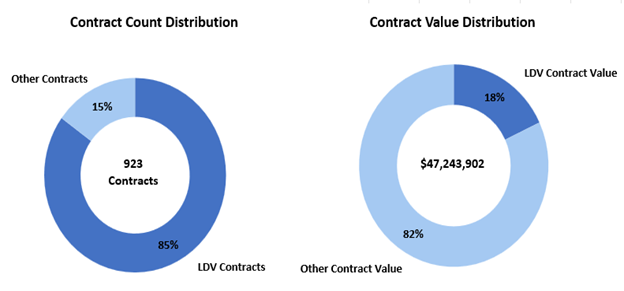
- At CAS, most professional service contracts are low dollar value procurements (Exhibit 2). While they may have low materiality, they represent about 84% of the number of professional service contracts CAS awarded annually. In 2023-24, CAS awarded 267 contracts for professional services valued at about $16.7 million. Of these contracts, 224 (84%) were LDV contracts totalling approximately $2.2 million (13% of $16.7 million).
- LDV professional services contracts may be prone to more errors due to less oversight. More reliance may be placed on delegated business owners who may be less familiar with complex procurement rules, increasing this risk.
Exhibit 2: Professional services contracts at CAS typically do not exceed $40,000
(Contracts awarded 1 April 2021 to 30 September 2024)
Source: Source: CAS contract logs
-
Text version
Exhibit 2 shows two doughnut charts side by side. They each present all professional services contracts awarded by the Courts Administration Service between 1 April 2021 and 30 September 2024, in a different way.
- The chart on the left illustrates the total contract count distribution. In the center, the doughnut chart shows the total number of contracts awarded, which is 923. Around the center, the dark-colour partial ring shows that 85% of awarded contracts had a value of less than or equal to $40,000 (low dollar value) and the light-colour partial ring shows that 15% of awarded contracts had a value greater than $40,000.
- The chart on the right illustrates the total contract value distribution. In the center, the doughnut chart shows the total dollar value of contracts awarded, which is $47,243,902. Around the center, the light-colour partial ring shows that 82% of awarded contracts had a value of less than or equal to $40,000 (low dollar value) and the dark-colour partial ring shows that 18% of awarded contracts had a value greater than $40,000.
Focus of the audit
Objective
- The objective of the audit was to determine if CAS’s procurement of LDV professional services was managed in accordance with procurement rules to enable operational outcomes while demonstrating sound stewardship and value for money.
Scope and approach
- The audit examined low dollar professional service contracts at CAS. The audit included all three phases of the procurement process – planning, bidding and contract award, and contract management, as well as oversight and guidance (Exhibit 3).
- It examined LDV professional services contracts that had ended during the period 1 April 2023 to 30 September 2024 (Exhibit 4). A judgmental sample of 20 contracts was reviewed to test compliance to rules and good practices across all phases of the procurement process. Ten of these contracts were Corporate Services Sector contracts and ten were from Judicial & Registry Services. In addition, the audit examined an additional 20 contracts for specific high-risk elements including security requirements, amendments, and respecting contracting limits.
- The audit excluded contracts:
- issued by common service providers such as Public Service and Procurement Canada (PSPC) and Shared Services Canada (SSC) where CAS was not the contracting authority;
- procured using acquisition cards; and
- contracts awarded for the Internal Audit Division (to eliminate potential conflicts of interest).
- This audit was approved as part of the 2024-25 to 2025-26 Internal Audit Plan. More details about the engagement are in Appendix A - About the Engagement.
Exhibit 3: Procurement processes included in the audit
| Planning | Bidding and contract award | Contract management |
|---|---|---|
|
|
|
| Oversight and Guidance | ||
Exhibit 4: Population of LDV professional services contracts included in the audit
(Contracts with end dates between 1 April 2023 to 30 September 2024)
| Type of Professional Service | Number of Contracts | Percentage of Contracts | Value | Percentage of Value |
|---|---|---|---|---|
| Consultants (i.e. Information Technology, Business, Human Resources, etc.) | 48 | 17% | $1,148,536 | 45% |
| Hospitality | 3 | 1% | $7,207 | 1% |
| Interpretation Services | 86 | 30% | $329,611 | 13% |
| Legal Services | 3 | 1% | $68,629 | 3% |
| Protection Services/Court Ushers | 55 | 19% | $277,423 | 11% |
| Training | 22 | 8`% | $186,594 | 7% |
| Vehicle Related Expenses | 6 | 2% | $84,534 | 3% |
| Court Reporting/Translation/Photography | 31 | 11% | $251,265 | 10% |
| Cleaning/Maintenance/Shredding | 30 | 11% | $169,283 | 7% |
| Total | 284 | 100% | $2,523,081 | 100% |
| Source: CAS contract logs | ||||
Findings and Recommendations
Planning for LDV professional services
- Following procurement directives during the contract planning process ensures that requirements are clearly defined and supported by accurate budgets and timelines to achieve business outcomes. It promotes fair and transparent competition, reduces the risk of delays or cost overruns, and provides a defensible basis for contract award decisions.
Expectations for planning
- Requirements clearly defined
- Costs estimated prior to reqesting a quote
- Procurment strategy defined, including justification of sole source contracting and why a task could not be completed by a public servant
- Expenditure initiated by authorized person and funds set aside (section 32 of the FAA)
Requirements defined, approvals in place, procurement strategy justifications frequently missing.
- Business owners often proceeded with sole source contracts without consistently preparing cost estimates or documenting their rationale. While CAS generally defines requirements and secures financial authorization before awarding LDV professional service contracts, preparing and documenting cost estimates in advance would allow business owners to better assess vendor proposals and make more informed contracting decisions. Results of the contract file review for the procurement planning phase are included in Exhibit 5.
- Requirements were generally well defined in advance. Of the 20 contracts tested, the requirements were clearly described in a statement of work (SOW) or purchase order (PO) before CAS awarded the contract in 85% of the time (17/20). One contract had vague information with minimal detail. In two other cases, work was started and finished before a contract could be put in place due to last-minute requirements. Establishing requirements clarifies performance expectations, making it possible to measure the quality of deliverables and demonstrate that value for money is being achieved.
- Cost estimates were not on file prior to contacting suppliers. Business owners did not estimate, or did not document in the procurement file, the estimated costs of the services they intended to procure before requesting quotes from suppliers in any of the 20 cases examined. Without an initial assessment of expected contract costs, CAS may lack the necessary information to assess whether the contract's potential benefits justify its costs. The risks increase in LDV procurements that are sole-sourced (i.e., contracts directed to a single supplier) where there is an absence of comparative pricing to determine if a quoted price represents fair value.
- Proper justification of sole source contracts was missing more than half the time. The audit reviewed 14 files that were non-competitive (six of the 20 contracts were classified as competitive procurements conducted through a supply arrangement). Among the 14 sole-sourced files, five (36%) included a reference to the applicable exemption (not exceeding $40,000) under the GCR that permits the use of a non-competitive process.
- When using a non-competitive approach, the rationale must be clearly documented, with explicit reference to the applicable exemption. This documentation is essential to demonstrate fairness, openness, transparency, and how best value was achieved. It should be done before soliciting quotes or engaging a supplier. While directed contracts are allowed under certain conditions, they should not be routine simply because they are permitted. Sole-source contracts limit competition and can affect pricing or service quality.
- In some cases, CAS documented justification explaining why a task could not be completed by a public servant. Four of the 20 (20%) LDV professional services procurement files reviewed had justification as to why the contracted work could not be completed by a public servant. This justification is not mandatory when procuring professional services that do not exceed $40,000 but it is a good practice for most professional service contracts, especially in a time when workforce adjustment and service optimization measures are in effect.
- Expenditure initiation and commitment of funds were authorized in all cases For all the 20 files reviewed, an internal requisition form was on file and was approved by a person with the appropriate section 32 delegated authority. Properly committing the funds helps avoid financial surprises and ensures that business owners do not exceed their budgets.
Exhibit 5: Results of the file review for planning phase
| Area examined | Number of applicable files | Number of files that met expectations | Percentage of files that met expectations |
|---|---|---|---|
| Requirements were clearly defined and on file before a contract was in place. | 20 | 17 | 85% |
| Cost estimated prior to receiving quotes not on file | 20 | 0 | 0% |
| Sole source justification on file | 14 | 5 | 36% |
| Rationale on file for why a Public Servant could not do the work | 20 | 4 | 20% |
| Internal requisition is on file: expenditure initiation |
20 | 20 | 100% |
| Appropriate authority to commit funds (section 32 of the FAA) | 20 | 20 | 100% |
Bidding and contract award for LDV professional services
- Procurement directives for bidding and awarding contracts ensure that competition is promoted, qualified vendors are selected, responsibilities are clear before work begins, and principles of openness, fairness, transparency, and integrity are upheld, reducing financial and legal risks.
Expectations for bidding and contract award
- Quotes sought and assessed to ensure pricing is fair and reflect fair market value
- Work started after contract is in place
- Contract signed by authorized parties (section 41 of the FAA)
- Security level required to complete work assessed and contractor's levels verified
- Contractors informed of the need to follow the Code of Conduct for Procurement
- Contract information proactively disclosed
Suppliers and security vetted, contracts disclosed, some work began before contracts signed.
- All contracts were properly authorized under section 41 of the FAA, security requirements were met, and contracts were proactively disclosed. Multiple quotes were not requested, and work began before contracts were signed in some cases, highlighting opportunities to improve value for money and competitive fairness. Results of the contract file review for the bidding and awarding phase are included in Exhibit 6.
- A quote from the supplier was generally on file, but some documentation missing. In 19 of the 20 cases examined, business owners received a quote or proposal from the vendor. The exception was for one contract for court usher services. The procurement team noted that all court usher contracts had a pre-established firm hourly rate. This agreement was not documented in the file.
- Six files required a certain level of experience for the services provided. While the level of the resource included in the proposal met the requirements, two of the six files (33%) included a resumé confirming their experience.
- While not required or standard practice, seeking multiple quotes for LDV procurements could enhance value for money. Of the 20 files examined, none had multiple quotes on file. At CAS, the general practice is to not obtain more than one quote for LDV procurements. While procurement rules do not require departments to obtain multiple bids when the estimated value of a service does not exceed $40,000, organizations are expected to seek bids when it is considered cost-effective. A determination is left to the discretion of each organization based on their unique risk profiles and operational contexts.
- Relying too much on sole-source contracts increases the risk of repeatedly giving similar work to the same vendor. This practice may lead to splitting requirements across multiple contracts to the same vendor or awarding multiple contracts in a row to the same service provider.
Opportunity for Improvement
Requiring business owners to seek multiple quotes, or to justify why it is not cost-effective to do so for low dollar value procurements, would increase competition and transparency and may reduce costs.
- Work started before contracts were awarded. Data analysis of the 284 LDV contracts examined from 1 April 2023 to 30 September 2024 showed that work appeared to have started before a contract was awarded in 30 cases (11%), valued at $234,090. Approximately 37% of these cases (11/30) were to procure interpretation services, which can often be requested last minute by a party prior to a Court hearing. Interpretation services made up 30% of all contracts awarded in the scope of the audit. Initiating work without a signed agreement exposes the organization to legal and financial risks, such as disputes over deliverables and payment terms.
- Integrity checks were conducted when required. Under PSPC’s Ineligibility and Suspension Policy, CAS must submit integrity verification requests to the Office of Supplier Integrity and Compliance to validate the eligibility of their prospective supplier. This must be done prior to awarding a contract or issuing a purchase order, standing offer or supply arrangement, at or above $10,000, with some exceptions. In all four applicable cases there was evidence that the integrity check was completed.
- Code of Conduct for Procurement is not explicitly communicated to vendors. CAS communicates the Code of Conduct for Procurement to vendors through standard clauses and conditions in the contract. While CAS contracts were built from PSPC templates, they did not include explicit reference to the Code as referenced in PSPC standard acquisition clauses and conditions. Instead, they included a link to the GC online procurement website (CanadaBuys) where the code can be found.
Code of Conduct for Procurement: The code is a statement of the ethical, legal and social expectations for vendors and subcontractors doing business with the GC. Departments are required to communicate the Code before work is started.
- As part of its 2024 contracting modernization, PSPC updated contract templates to include content directly in its contracts that had previously been linked by reference, including the requirement for contractors to comply with the Code of Conduct for Procurement and a link to the Code. As of July 2025, CAS had started the process to implement PSPC’s updated templates. When purchase orders are used instead of contracts, the Code was not communicated. Purchase orders represented 36% of the population of files in the scope of the audit (102/284 files).
- All contracts were properly authorized by CAS, although vendor acknowledgement was not on file for most purchase orders. All procurement files tested were properly signed by a CAS representative with valid delegated contracting authority in accordance with section 41 of the FAA. However, five of them did not have a vendor signature or acknowledgment on file - four of these five cases were purchase orders. Unlike a contract, the purchase order form does not include a section for vendor signature, only one for CAS’s signature. The current practice at CAS is to request an email acknowledging the terms of the purchase order by the vendor. Having contracts and purchase orders signed or acknowledged by suppliers, and maintaining these documents on file, ensures legal enforceability, mutual understanding and accountability.
- Security requirements were met for the duration of the contract but clarity in roles and responsibilities is needed. Contractors held valid security clearances, for all nine of the contracts tested that required a security clearance. When the duration of the contract is extended, the procurement officer should check that security clearances remain valid. There was no evidence on file to demonstrate that this revalidation for amended contracts occurred. Nonetheless, subsequent evidence confirmed that proper security was in place for the duration of the contracts, including for contracts amendments to increase the time. Roles and responsibilities between the procurement and the security teams for the revalidation of security clearances prior to issuing a time extension are not documented. This lack of clarity may lead to accountability issues amongst stakeholders.
- Contracts were proactively disclosed, but risks exist to the disclosure of contracts to former public servants with pensions. To maintain transparency and accountability, the GC requires departments to proactively publish any contract valued at more than $10,000. From the sample of 20 procurement files, eight were less than $10,000 and did not require proactive disclosure. Of the 12 remaining files, 100% were proactively disclosed.
- One of the requirements for public disclosure is to indicate when a contract is awarded to a former public servant in receipt of a Public Service Superannuation Act pension. It was not clear in the procurement files how this status was verified. The process to conduct this validation is not documented. The review of the contracting data highlights a potential risk that this verification is not being effectively completed.
- Analysis of the data population suggests some opportunities. Of LDV professional services contracts ended between 1 April 2023 and 30 September 2024, 60% were under $5,000 (171/284), representing $301,796 or approximately 13% of the population’s value. Each individual contract requires time and effort from both the business owner and the procurement team within the Corporate Services Sector. For example, for this same period over 80% (70/86) of contracts for interpretation services were under $5,000. This pattern suggests opportunities to increase both competition and efficiency by considering requirements for similar services collectively for the department.
Exhibit 6: Results of the file review for bidding and award phase.
| Area examined | Number of applicable files | Number of files that met expectations | Percentage of files that met expectations |
|---|---|---|---|
| Multiple quotes solicited to ensure fair price | 20 | 0 | 0% |
| Vendor quote or proposal on file | 20 | 19 | 95% |
| Resume on file | 6 | 2 | 33% |
| Integrity check performed with PSPC | 4 | 4 | 100% |
| Contract properly authorized (section 41 of the FAA) | 20 | 20 | 100% |
| Security requirements met for duration of Contract | 9 | 9 | 100% |
| Code of conduct for procurement communicated to vendor | 20 | 13 | 65% |
| Proactive disclosure completed | 12 | 12 | 100% |
Contract management for LDV professional services
- Effective contract management of professional service contracts, from the date of award through to close out, is essential to ensure that both parties fulfill their obligations, risks are minimized, and business outcomes are met. Good contract management practices help maintain clear communication, track progress, control costs, and address issues promptly. Proper documentation for all aspects of the contract is essential for accountability and decision-making.
Contract management expectations
- Contracted deliverables received as described in the signed agreement
- Vendor performance monitored against agreed timelines and quality
- Invoices authorized by people with appropriate authority under section 34 of the FAA
- Contracts amended before expiry date and in accordance with directives
- Relevant records and documentation maintained
Vendor performance monitored, some amendment rules not followed, and improvement needed in managing information.
- In general, contracted services were received as planned. Business owners monitored vendor performance by reviewing timesheets and deliverables. However, amendments are frequent and rules were not always followed. Record keeping practices varied amongst business owners. Results of the contract management phase are included in Exhibit 7.
- Business owners monitored vendors to ensure services were provided. All examined files showed that the business owner actively monitored the contractor’s performance through communications, receipt of timesheets and deliverables, and amending contracts.
- Deliverables were received for 17 of 19 files in line with the established contract. In the two other cases, business owners still demonstrated effective contract management:
- In a contract for court reporting services, CAS did not receive the transcript from a court proceeding from the vendor and, after multiple attempts to obtain the deliverable, the transcription request was cancelled without payment.
- In one information technology (IT) related contract, the original task was replaced with a different deliverable. According to the business owner, this work was verbally agreed by both parties and met an urgent organizational priority. Although this case may demonstrate contract monitoring, the contract was not amended to reflect the scope changes and the agreement between parties was not fully documented.
- All the contracts requiring timesheets had them on file to support the work completed (15/15). They detailed the nature of service performed and the time it took to complete various tasks.
- Invoices were properly certified. All invoices were properly certified before payment. For the 18 files where payments were made, each was approved by a business owner with delegated authority, confirming that services were received and met contract terms, as required under section 34 of the FAA.
- A large volume of LDV contracts were amended and some cases where rules were not followed. Professional service contracts can be amended to change the dollar value, the scope of the work, deliverables, etc. In all cases, justification for the change must be documented and agreed upon by CAS and the vendor. For the population of 284 contracts LDV contracts examined, 24% were amended, resulting in an increase in value from $0.90 million to $1.13 million or a 20% increase. When a contract was amended, it was amended more than once over 50% of the time. No contracts in the population subject to the GCR were amended from below $40,000 to above this sole-source threshold.
- Amendments require time and effort from both the business owner and the procurement team within the Corporate Services Sector. The high number of contracts being amended indicates opportunities to improve planning and increase efficiency for the procurement of LDV professional services.
- Of the contracts reviewed, 12 contained amendments. Of these, nine complied with good procurement practices (75%) and three (25%) did not.
- A contract was amended shortly after the expiration date instead of a new contract being put in place.
- For two amendments for services arranged through purchase orders, the vendor acknowledgment of the changes was not on file.
- Information management could be improved. The procurement team maintains an electronic folder for each procurement in the official CAS repository (Themis), covering aspects of procurement that fall directly under their responsibilities. In contrast, there is no specific CAS guidance for business owners that establishes what, how and where contract documentation, including key communication with vendors and contract deliverables, are to be maintained. Business owners documented contract information in various ways, such as within Themis, personal desktop folders and in email repositories. Although evidence was available when requested, there is a risk that information of business value may be lost due to turnover of employees when information is not stored within the CAS official information repository. Guidelines and templates, including consistent file structure for business owners that is linked to the procurement team’s file would reduce risks around transparency and the organization’s ability to demonstrate compliance with procurement rules.
Exhibit 7: Results of the file review for contract management
| Area examined | Number of applicable files | Number of files that met expectations | Percentage of files that met expectations |
|---|---|---|---|
| Evidence of on-going contract monitoring on file | 20 | 20 | 100% |
| Deliverables received | 19 | 17 | 89% |
| Detailed timesheets on file | 15 | 15 | 100% |
| Invoices properly certified (section 34 of the FAA) | 18 | 18 | 100% |
| Amendments approved prior to contract ending | 12 | 9 | 75% |
Procurement oversight and guidance
- Effective procurement oversight and clear guidance are essential to ensure transparency, fairness, and value for money in the use of public funds. Strong oversight helps support the planning and execution of procurement strategies, while consistent guidance supports compliance with directives and regulations. It also promotes accountability, streamlines processes, and enables informed decision-making.
Oversight and guidance expectations
- The procurement governance committee is functioning as intended
- CAS-specific procurement guidance is available to procurement officers and business owners.
- Processes for legal services contracts are up-to-date
Procurement oversight and guidance is lacking or out of date.
- 52. In 2018, the Office of the Procurement Ombuds (OPO) conducted a review of CAS procurement management control framework. It found weaknesses in the Contract Review Committee’s (CRC) operations, a lack of CAS-specific procurement guidance and directives, and opportunities to improve the documentation governing procurement practices for legal services. The recommendations by OPO to address these issues were either not implemented or not kept up to date.
Office of the Procurement Ombuds A neutral and independent organization of the GC that works collaboratively with federal organizations and Canadian businesses to promote openness, fairness, and transparency in federal procurement, and making recommendations for improvements.
- CAS’s procurement governance committee was not operating as intended. CAS updated the terms of reference for its CRC in September 2018 after the OPO report recommended that it needed to clearly describe the CRC’s role, membership, and member responsibilities. In 2023, the CRC was internally assessed as functioning as intended with additional updates required to the terms of reference. However, based on file review, CRC involvement for some procurements was limited to a few members of the committee, including the Director of Procurement and occasionally the Corporate Counsel. In addition, records documenting the CRCs decisions were not maintained in minutes or records of decisions but rather, individual procurement files contained emails from committee members with their feedback and some approvals. There did not appear to be a rationale as to why one procurement required CRC review while other procurements did not need their oversight.
- Efforts are ongoing by management to relaunch the CRC and to approve an updated term of reference. As of July 2025, the CRC terms of reference were updated with a new Chair, membership list, and roles and responsibilities, and it was scheduled for review and approval at an upcoming Executive Committee meeting. As part of this work, the Internal Audit Division provided advice on the suitability of the design of the Committee as an important procurement control to maintain the integrity of the procurement process and foster accountability.
- CAS’s procurement procedures and guidance are not up to date. Since the OPO report in 2018, CAS developed and approved its policy on procurement in August 2020 and some relevant checklists. The policy and tools were made available to the procurement team. Since that time, government procurement rules related to professional services were updated multiple times by PSPC. CAS officials indicated challenges in updating its own internal procedures accordingly due to the high volume and frequency of changes.
- As of July 2025, CAS’s procurement policy and guidance to support the procurement team had not been updated and guidance was not developed specifically to support business owners. Tailored guidance specific to CAS is important for the procurement team and business owners to help improve the consistency and compliance with procurement rules including for LDV procurement, where minimal government guidance is available. It would also help empower the small procurement team to provide a stronger challenge function and to better support business owners in making procurement decisions.
- CAS’s policy on contracting for legal services is outdated. Between April 2021 and March 2024, based on available data, CAS awarded 14 legal services contracts. After the Procurement Ombuds report in 2018, CAS approved a policy on contracting for departmental legal services in 2021. It was not updated to reflect current authorities within the organization since a change in roles and responsibilities in 2024. As the GCRs do not apply to legal contracts, it is important for CAS to keep internal policies updated and ensure it is appropriately socialized.
Legal service contracts are professional services that are exempt from the GCR and may not follow the same process as other professional service contracts.
Recommendations
- The Senior Designated Official for the management of procurement should strengthen oversight of procurement:
- Re-establish an effective procurement governance committee with a clear mandate and membership.
- Develop a procurement strategy for low dollar value professional services currently being procured on a recurring basis. A proactive, strategic approach should support fair and open competition, improve operational efficiency, and reduce work starting before contract award and amendments.
- Ensure the procurement team is equipped to play a strong control and challenge function within the organization.
- The Senior Designated Official for the management of procurement should ensure that CAS’s policy on contracting for legal services is kept up to date. Corporate Counsel should lead the update of the CAS policy and should work with the Senior Designated Official for the management of procurement and the Deputy Chief Administrator Judicial & Registry Services to communicate the updates to interested stakeholders.
- The Senior Designated Official for the management of procurement should communicate CAS’s procurement policy and update/develop CAS-specific procurement guidance including checklists, to help procurement staff and business owners appropriately meet their obligations for procurement of low dollar value professional services. Guidelines should address all phases of the procurement process and the findings and opportunities from this report. CAS should have clear practices to manage last-minute needs, avoid situations where work is started before a contract is in place and clarify the use of purchase orders.
- The Senior Designated Official for the management of procurement should provide guidance to business owners on what information should be documented for low dollar value procurement and where and how it should be recorded in the CAS official records system.
Management’s Response
Management’s action plans in response to each recommendation are included at the end of this report in Appendix B - Management Action Plan.
Conclusion
CAS’s procurement of low dollar value services, while enabling operational outcomes, struggles at times to demonstrate sound stewardship and value for money.
CAS has shown it can achieve its operational outcomes through its low dollar procurement practices. Business owners define procurement needs, monitor security clearances and vendor performance to ensure that professional services meet expectations. Additionally, the department has strong procedures that ensure financial obligations are backed by appropriate approvals.
Certain CAS practices jeopardize stewardship of public funds and value for money. Contracts were awarded after work had already begun and the use and management of amendments for low dollar value contracts should be improved. There is a need to re-establish oversight over procurement and update the policy for legal services procurement.
There are also opportunities to rethink how low dollar value, yet recurring, professional services that are integral to the function of the organization and the Courts are procured thereby improving competition as well as efficiency.
Due to recent scrutiny in government procurement, there has been many rule changes mostly affecting procurement that exceed $40,000. Given there is minimal guidance for low dollar value procurement, many of these practices and principles could be applied to low dollar value procurement. The lack of guidance is a strong contributing factor to the concerns identified in this audit. CAS-specific guidance on procurement would help ensure compliance with rules such as cost estimation, properly handling amendments, and document retention. Guidance would also help equip the procurement team to serve as a strong control and challenge function.
Procurement directives, regardless of contract value, are designed to help organizations secure the services needed to support their programs and deliver value to Canadians, ensuring the best value for the Crown. Directives for low dollar value procurement allow flexibility in how services are acquired, even so, it is crucial to uphold key principles of being open, fair, and transparent.
I would like to thank the officials from the Courts Administration Service, and particularly the procurement team, for their collaboration and support provided to the Internal Audit Division.
Jennifer McLeod, CIA, CPA, CMA
Chief Audit Executive
Appendix A – About the Engagement
Objective
To determine if CAS’s procurement of low dollar value (LDV) professional services is managed in a manner that enables operational outcomes and demonstrates sound stewardship and value for money by complying with procurement rules.
Scope
The audit included all phases of the procurement cycle for low dollar value procurements for professional services. It examined planning, bidding and award, and contract management along with general oversight and guidance functions. Specifically, the scope was professional services contracts with an original value that did not exceed $40,000 (including applicable taxes) and the contract ended between 1 April 2023 and 30 September 2024.
During this time there were 284 LDV professional services contracts (approximately $2.5 million).
Data on contracts awarded by CAS for professional services from April 2021 to September 2024 was analyzed for trend and risk analysis.
Exclusions:
- contracts for professional services by common service providers (i.e. PSPC and SSC as the contracting authority),
- procurements using acquisitions cards, and
- for independence reasons, four contracts for the Internal Audit Division (valued at about $101,000 that ended between 1 April 2023 and 30 September 2024).
IAD authority extends only to administrative matters under the powers of the Chief Administrator and does not extend to any matter assigned by law to the judiciary (i.e. excludes judicial functions and information).
Approach
To conduct this audit engagement, the methodologies used included, but were not limited to, the following:
- Review and analysis of documentation, including Government of Canada and CAS policies, guidelines and procedures.
- Interviews and discussions with CAS staff.
- Data analysis of CAS professional services contracts awarded from 1 April 2021 to 30 September 2024 for trends, risks and anomalies
- Data analysis of the population of LDV professional services contracts that ended between 1 April 2023 and 30 September 2024.
- Detailed file review for a judgmental sample of contracts from both Corporate Services and Judicial & Registry Services:
- Judgmental sample of 20 contracts for a complete file review across all phases of the procurement cycle. The total original value of these contracts was $443,069.
- An additional 20 contracts, selected for review based on various risk factors. Examination of these files did not include all elements, rather focussed on risk elements such as contracts started before award, amendments, proactive disclosures, security clearances, and respecting contracting limits.
Criteria
We used the following criteria to conclude against our audit objective:
| Criteria | |
|---|---|
| Planning and awarding of contracts Source: Canada Buys – Procurement Process, GCRs, Directive on the Management of Procurement |
Procurement of LDV professional services were planned and contracts awarded in accordance with procurement rules to demonstrate sound stewardship and value for money. Included but not limited to:
|
| Contract management Source: Canada Buys – Procurement Process, GCRs, Directive on the Management of Procurement |
Contracts for LDV professional services were managed in accordance with procurement rules to help achieve operational outcomes and demonstrate sound stewardship and value for money. Included but not limited to:
|
| Oversight and guidance Source: GCRs, Directive on the Management of Procurement |
Oversight and guidance have been established to support the procurement of professional services. Included but not limited to:
|
Period covered by the audit
The engagement examined CAS’s professional services contracting data from 1 April 2021 to 30 September 2024. Whereas the contracts selected for review were contracts that had been closed between 1 April 2023 and 30 September 2024. This period is the timeframe to which the engagement conclusion applies. However, to gain a complete understanding of the subject matter, we also examined certain procurement-related matters that preceded the start date of this period and occurred up to the date of this report.
Date of the report
We obtained sufficient appropriate evidence and validation on which to base our conclusion by 12 August 2025.
Conformance with professional standards
This internal audit was conducted in conformance with the International Standards for the Professional Practice of Internal Auditing.
Appendix B – Management Action Plan
| Recommendations | Management Action Plan |
|---|---|
|
R1. The Senior Designated Official for the management of procurement should strengthen oversight of procurement:
|
1. Management Action
Closure/Deliverable: R1a) Will be closed after the CRC TOR is approved and regular meetings have occurred. R1b) Will be closed after procurement strategies for recurring low dollar value professional services have been tabled at CRCs. R1c) Will be closed after the Procurement Competency Framework is incorporated into PMAs, training is occurring as planned and opportunities for improvements are identified. Office of Primary Interest (OPI): ADM Corporate Services Sector, CFO and CSO, as the Senior Delegated Official for the management of procurement. Office of Collateral Interest (OCI): N/A Target date: 31 March 2026 |
|
R2. The Senior Designated Official for the management of procurement should ensure that CAS’s policy on contracting for legal services is kept up to date. Corporate Counsel should lead the update of the CAS policy and should work with the Senior Designated Official for the management of procurement and the Deputy Chief Administrator Judicial & Registry Services to communicate the updates to interested stakeholders. |
2. Management Action Corporate Counsel will lead the update on the CAS Policy on Contracting for Legal Services, in collaboration with the procurement team and the Deputy Chief Administrator Judicial & Registry Services. This review will ensure the policy continues to respect the spirit of government procurement rules while respecting judicial independence, CAS’s operational requirements and the need for effective risk management. Upon approval, the policy will be communicated to appropriate stakeholders and committees. Closure/Deliverable: R2 will be closed after the legal services contracting policy has been updated and communicated. Office of Primary Interest (OPI): Corporate Counsel Office of Collateral Interest (OCI): ADM Corporate Services Sector, CFO and CSO, as the Senior Delegated Official for the management of procurement, and the Deputy Chief Administrator Judicial & Registry Services Target date: 30 September 2026 |
|
R3. The Senior Designated Official for the management of procurement should communicate CAS’s procurement policy and update/develop CAS-specific procurement guidance including checklists, to help procurement staff and business owners appropriately meet their obligations for procurement of low dollar value professional services. Guidelines should address all phases of the procurement process and the findings from this report. CAS should have clear practices to manage last-minute needs and avoid situations where work is started before a contract is in place and clarify the use of purchase orders. |
3. Management Action The procurement team will analyze contract data to identify services that are frequently purchased, including those that regularly start before contract award and those that could be purchased with an Acquisitions Card rather than using a contract or confirming order. The procurement team will work with business owners to help them with the planning of their requirements by introducing a detailed procurement plan as well as implementing time and/or financial buffers on contracts related to court operations. These efforts should help reduce work starting before contracts are awarded, reduce amendments, and reduce going over the contracted dollar value. Closure/Deliverable: R3 will be closed after the procurement policy is posted on the intranet and guidance documentation (e.g. checklists, procedures, tools) are created/updated and being used by the procurement team and the requirement for business owner checklists is analyzed. Office of Primary Interest (OPI): ADM Corporate Services Sector, CFO and CSO, as Senior Delegated Official for the management of procurement Office of Collateral Interest (OCI): N/A Target date: 30 September 2026 |
|
R4. The Senior Designated Official for the management of procurement should provide guidance to business owners on what information should be documented for low dollar value procurement and where and how it should be recorded in CAS official records system. |
4. Management Action Closure/Deliverable: R4 will be closed after a framework is developed to identify documentation requirements for all parties throughout the procurement lifecycle. Office of Primary Interest (OPI): ADM Corporate Services Sector, CFO and CSO, as the Senior Designated Official for the management of procurement. Office of Collateral Interest (OCI): N/A Target date: 31 March 2027 |
- Date modified: