
Departmental Results Report 2021–22
The Departmental Results Report (DRR) is published in PDF and HTML formats.
The Honourable David Lametti, Q.C., P.C., M.P.
Minister of Justice and Attorney General of Canada
Table of Contents
- Spending
- Human resources
- Expenditures by vote
- Government of Canada spending and activities
- Financial statements and financial statements highlights
- Organizational profile
- Mandate and role: who we are and what we do
- Operating context
- Reporting Framework
- Supporting information on the Program Inventory
- Supplementary information tables
- Federal tax expenditures
- Organizational contact information
From the Chief Administrator
I am proud to present the 2021–22 Departmental Results Report for the Courts Administration Service (CAS). I am pleased that in my second year as Chief Administrator, CAS continued to operate successfully under challenging conditions. Our overarching goal is to provide, at arm’s length from the Government, administrative services to the Federal Court of Appeal (FCA), the Federal Court (FC), the Court Martial Appeal Court of Canada (CMAC) and the Tax Court of Canada (TCC) (the “Courts”). Doing this effectively increases public confidence in Canadian institutions and the rule of law. Beyond continued pandemic management in 2021–22, our four strategic priorities continued to guide our activities and the delivery of our services: Digital Courts, Workforce of the Future, National Court Facilities and Courtrooms, and Service Excellence. This report highlights accomplishments and results achieved in delivering our mandated services.
Given recent challenges to institutional and social trust, CAS is keenly aware of its role in safeguarding what is precious to us all—a fair, impartial, and independent judiciary that can render decisions free of influence based solely on facts and law in a highly complex and fluid environment.
As the global pandemic continued to constrain operations across government, our dedicated workforce rose to the occasion and attended admirably to the evolving needs of the Courts and Canadians, ensuring continued and uninterrupted access to justice for all. Even before COVID-19, CAS was pursuing the implementation of modern technology to improve services and access to justice. Digitization and automation of the Courts’ operations were already under way; the pandemic only accelerated our efforts. CAS made great advances in improving service delivery, delivering digital solutions, and conducting virtual, hybrid and in-person hearings and trials. We expanded the Courts’ capacity to receive electronic documents and payments, digitized court documents, added to our range of self-service offerings, and improved the accessibility and design of the Courts’ websites. Furthermore, thanks to rigorous safety measures put in place to limit the potential transmission of COVID-19, the Courts remained open for in-person hearings.
None of this would have been possible without the incredible dedication of our staff. CAS is constantly striving to build a staff complement that is more inclusive, more diverse and more reflective of the Canadian mosaic. The pandemic heightened the importance of investing in our workforce and, in 2021–22, we made investments in recruiting, developing and retaining our highly qualified workforce. I believe that the results speak for themselves.
We have also made major advances in infrastructure improvements. Modernizing courtroom facilities has been prioritized across the country and will be under way in the near future; these facilities will allow for greater flexibility, safety and functional use of space to better serve Canadians.
With creative responses to the pandemic challenges, we seized the opportunity to expand lessons learned to continue implementing enhanced and sustainable solutions and services. Our combined efforts are bringing Canada’s Courts into the 21st century. I want to acknowledge and express my sincere appreciation for the professionalism, agility, skill and innovativeness that I have seen through these challenging times. In addition, I remain grateful for the close collaboration of the Chief Justices, the Associate Chief Justice of the Federal Court, and all members of the Courts, whose commitment to a fair, impartial and independent judiciary is unwavering, and whose partnership is instrumental to our continued success.
Darlene H. Carreau LL.B.
Chief Administrator
Results at a glance
In 2021–2022, CAS continued to operate in a complex and dynamic environment in which it was necessary to respond to emerging threats and global trends along with the evolving and unique needs of each Court in the exercise of its particular role in rendering decisions, and in interpreting and deciding on questions of law. To deliver on its core responsibility, CAS was proactive, adaptive and innovative. CAS also advanced the process of modernizing its technological capabilities, and mobilized its resources to ensure the integrity and accessibility of our court system.
The CAS Departmental Results Framework specifies three planned results:
- Members of the Courts are provided with the required information and support services to hear matters and render decisions.
- Members of the Courts, court users and the public can access court services, court decisions and processes electronically without undue delays.
- The Courts maintain their ability, as the government’s independent judicial branch, to protect judicial independence and access to justice.
To achieve these results, CAS identified four priorities for 2021–22: Digital Courts; Workforce of the Future; National Court Facilities and Courtrooms and Service Excellence. All of the results were achieved with the added challenge of responding to the COVID-19 pandemic.
Key results achieved during the last fiscal year in each area are as follows:
| Priority | Results Achieved |
|---|---|
|
Digital Courts |
Court and Registry Management System (CRMS)
Modernizing services to improve access to justice
|
|
Workforce of the Future |
|
|
National Court Facilities and Courtrooms |
|
|
Service Excellence |
|
For more information on the Courts Administration Service’s plans, priorities and results achieved, see the “Results: what we achieved” section of this report.
Results: what we achieved
Core responsibility
Administration services for the federal Courts
Description
CAS provides timely and efficient judicial, registry, court security and electronic court services to the FCA, the FC, the CMAC and the TCC; coordinates and balances the provision of services among the four Courts; and safeguards the independence of the Courts by placing administrative services at arm’s length from the Government of Canada.
The efficient and effective delivery of these services has implications beyond the organization. The broader federal policy agenda encompasses, among other things, effective public administration, modernization of infrastructure, digitization of records and processes, and sustainable development. As our results demonstrate, CAS has made positive contributions in these priority areas. Moreover, CAS also contributes indirectly to the Department of Justice mission to:
- support the Minister of Justice in working to ensure that Canada is a just and law-abiding society with an accessible, efficient and fair system of justice; and
- promote respect for rights and freedoms, the law and the Constitution.
The following table shows, for results specified in the CAS Departmental Results Framework, performance indicators, targets and the dates to achieve those targets for 2021–22, and the actual results (where available) for the three most recent fiscal years.
| Departmental results | Performance indicators | Targets | Date to achieve targets |
2019–20 actual results |
2020–21 actual results |
2021–22 actual results |
|---|---|---|---|---|---|---|
| Members of the Courts are provided with the required information and support services to hear matters and render decisions. | Percentage of court files that are complete and processed accurately. | Exactly 100% | March 31, 2022 | 92.5%* | 94%* | 96.5% |
| Members of the Courts, court users and the public can access court services, court decisions and processes electronically without undue delays. | Percentage of final court decisions posted on the Courts’ websites in both official languages, within established time frames. | At least 95% | March 31, 2022 | 92% | 80%** | 97% |
| Percentage of court documents that are filed electronically. | At least 80% | March 31, 2022 | 26.5%† | 54%† | 73% | |
| The Courts maintain their ability, as the government’s independent judicial branch, to protect judicial independence and access to justice. | Level of satisfaction of the members of the Courts with the security afforded to them in discharging their judicial functions. | At least a rating of 4 on a scale of 1 to 5 | March 31, 2022 | Not evaluated Ω | Not evaluated Ω | Not evaluated Ω |
| Level of satisfaction of the members of the Courts with the security afforded to them in discharging their judicial functions. | At least a rating of 4 on a scale of 1 to 5 | March 31, 2022 | Not evaluated Ω | Not evaluated Ω | Not evaluated Ω | |
|
Remarks: This compliance indicator has been growing by about two percentage points annually and is approaching the 100% target. Remarks: After a dip the previous year, the first indicator has exceeded the target in the current year. Although slightly below the target level, the second indicator has been growing significantly over the past few years, nearly tripling since 2019-20. |
||||||
*Represents the average for the FCA and FC. Results are not included for the CMAC as the sample size is too small to be statistically significant. The TCC does not track performance data for this indicator. ↩
**The percentage is lower than in previous years due to a high volume of court decisions to be translated, in addition to system limitations that affected the posting of decisions.↩
†Represents the average of court documents filed electronically across the Courts. ↩
Ω Measurement of these results has been deferred. ↩
Budgetary financial resources (dollars)
The following table shows budgetary spending for 2021–22, as well as actual spending for that year, for its core responsibility: administrative services for the federal Courts.
| 2021–22 Main Estimates |
2021–22 planned spending |
2021–22 total authorities available for use |
2021–22 actual spending (authorities used) |
2021–22 difference (actual spending minus planned spending) |
|---|---|---|---|---|
| 67,449,968 | 67,449,968 | 83,755,765 | 67,891,005 | 441,037 |
Financial, human resources and performance information for CAS’s Program Inventory is available
in GC InfoBase.Footnote ii
Human resources (full-time equivalents)
The following table shows, in full time equivalents, the human resources that the department needed in order to fulfill its core responsibility for 2021–22.
| 2021–22 planned full-time equivalents |
2021–22 actual full-time equivalents |
2021–22 difference (actual full-time equivalents minus planned full-time equivalents) |
|---|---|---|
| 567 | 562 | (5) |
Financial, human resources and performance information for CAS’s Program Inventory is available
in GC InfoBase.Footnote iii
Priority: Digital Courts
Description
Throughout the fiscal year, CAS undertook a number of initiatives to further modernize and enhance the use of technology in the Courts, to support the efficient operations of the Courts, to reduce costs, and to offer greater conveniences to litigants and lawyers.
- Essential investments in network infrastructure enhancements and systems continued in 2021–22 to improve the digital management of court business, modernize digital services, and prepare for the new CRMS. These investments also supported the phased transition from paper-based to digital courts, as well as facilitated and strengthened the capacity to provide online services to meet augmented demands.
- CAS also continued developing and maintaining existing applications to support court business digitally during the pandemic and proceeded with several other projects aimed at improving digital court services, including working with the Courts to enhance e-filing capabilities and to equip additional courtrooms to facilitate a more significant number of virtual hearings.
- In response to the pandemic, CAS launched a pilot project to increase the digitization of incoming and priority court documents to enable more efficient court records management. There has been a significant decrease in paper intake as most of the court documents received were transmitted through electronic means in 2021–22. Based on the success of this pilot project, CAS will explore options, including a detailed cost analysis, for the digitization of legacy court documents.
- Significant progress was made towards establishing definitions for judicial information, as well as a classification scheme and security standards. The Canadian Judicial Council (CJC) Blueprint for the Security of Judicial InformationFootnote iv calls for implementing multiple information management and information technology policies by each Court on the security, accessibility and integrity of judicial information. This includes adopting a standard definition of “judicial information”, as well as establishing a security classification scheme, retention schedule and document management system. The Courts adopted this definition of “judicial information” and endorsed a new Policy on Security Classification of Judicial Information: “judicial-public” and “judicial-protected.” The endorsement is critical to identifying a suitable electronic document repository and establishing protocols concerning document access controls.
- CAS also collaborated with the Courts to develop plans for phased approaches to the resumption of regular operations and in-person hearings and trials. These plans considered how best to deliver judicial, registry and administrative services to the Courts, while also allowing for agility and contingencies as the context evolved.
Priority: Workforce of the Future
Description
CAS’s diverse and skilled workforce is the foundation of our success. We are committed to ensuring an innovative, agile, and high-performing organization to support the requirements of the Courts. In 2021–22, CAS continued its recruitment efforts and invested in the training and well-being of our workforce to foster a work environment that is supportive of employees’ well-being and where they feel safe and a sense of belonging, whether working from the office or remotely.
- CAS continued to offer a number of initiatives focused on engagement and training related to resiliency, mental health and physical well-being. Frequent communications were disseminated to keep employees informed of the latest developments regarding the pandemic, the Courts’ and CAS’s response, as well as resources and tools.
- CAS provided ethical leadership training to managers and supervisors, and hosted sessions on civility and respect in the workplace for all employees in order to raise awareness about the CAS Code of Conduct and the Values and Ethics Code for the Public Sector.Footnote v
- CAS developed and implemented a new policy on the prevention of harassment and violence in the workplace. As well, CAS implemented its 2020–25 Anti-racism Strategy to eliminate systemic barriers and proactively address racial inequities and unconscious biases. Initiatives were undertaken to foster awareness of diversity, inclusion, anti-racism and equity through the Chief Administrator Anti-racism Consultation and Action Committee’s Speaker Series.
- CAS continued to support managers and employees working remotely, providing advice, guidance, and tools and procedures to help them adapt to the new reality. A variety of training modules were offered to employees to help them better navigate the rapidly evolving work environment.
Priority: National Court Facilities and Courtrooms
Description
In 2021–22, CAS continued to advance its 10-year National Accommodation Strategic Plan, which identifies priority projects to ensure that the Courts have the necessary judicial facilities and national presence to offer the level of service that Canadians require across the country, including in Ottawa, Montréal, Toronto, Hamilton, Winnipeg, Halifax, Victoria and Saskatoon.
- Infrastructure investments like these will ensure that court facilities and courthouses are fully accessible, secure and digitally enabled.
- These projects are being undertaken in keeping with Canada’s sustainable development agenda and reflect Canada’s adherence to the United Nations Sustainable Development Goals.
- CAS updated the BCP, which improved our response to emergencies or disasters, ensuring that critical services of the Courts continue with minimal disruption or delay.
Priority: Service Excellence
Description
The COVID-19 pandemic created opportunities to demonstrate resiliency and creativity to deliver what was needed to meet the challenges inherent in the above priority areas. In 2021–22, CAS continued to manage operations as the pandemic evolved to ensure uninterrupted access to justice, including planning for potential further waves or an endemic state.
Over the last two years of the pandemic, the importance of high-quality service came into sharp focus. Service excellence is a driving principle as we modernize service delivery in a continually shifting environment.
- CAS provided innovative ways to deliver justice remotely and online, as well as ensured safe access to our court facilities and courtrooms for in-person appearances.
- CAS is building a workplace culture of service excellence to entrench and improve service and quality standards in processes and practices; this is a key priority. To support this effort, CAS expanded its change management capacity by establishing a dedicated team to provide, advice, guidance and support to tackle key change initiatives.
- As part of pandemic management, CAS adjusted business processes and implemented multiple rigorous measures to limit the potential transmission of COVID-19 and protect the health and safety of members of the Courts, litigants, employees and the public.
- CAS continued to deliver programs and services in-person as well as in virtual and hybrid formats, and, as the pandemic began to wane, collaborated with the Courts to develop plans for phased approaches to resuming regular operations and an increased number of in-person hearings and trials.
- CAS undertook an organizational review and improvement of governance, financial and human resources management, and employee engagement to modernize practices, processes and tools.
CAS’s program delivery has impacts beyond the organization. Although CAS operates at arm’s length from the Government, the results we achieve have an indirect but positive impact on wider Department of Justice and Government of Canada priorities. Among these results are CAS’s achievements in the modernization of infrastructure and the digitization of records and processes. In ensuring continuity of operations throughout the pandemic, CAS helped protect access to justice for Canadians.
Gender-based analysis plus
Gender-based analysis plus (GBA Plus) is an analytical process that provides a rigorous method for assessing systemic inequalities and how groups of women, men, and gender-diverse people may experience policies, programs, and initiatives.
In 2021–22, CAS remained committed to utilizing and incorporating GBA Plus to ensure inclusive outcomes for Canadians who use its services. GBA Plus analysis was included in budget requests, and Treasury Board submissions and plans were put in place to enable more in-depth research and analysis of program data to support corporate decisions. In collaboration with organizational portfolio leads, approaches were also developed to ensure the ongoing and sustained application of GBA Plus in decision-making.
Currently at CAS, 73% of employees occupying the positions of registry officer, law clerk, judicial assistant or support clerk are women, 4.5% are persons with disabilities, and 28.4% are visible minorities.
United Nations 2030 Agenda for Sustainable Development and the Sustainable Development Goals
Consistent with the Government of Canada’s priority to reduce negative impacts on the environment and fight climate change, which is in line with the United Nations’ Sustainable Development Goal 13, CAS committed to working with Public Services and Procurement Canada to ensure that all construction projects for the Courts achieve a LEED Gold environmental certification and a BOMA Operating + Maintenance certification (or equivalent). A requirement for Fitwel certification (or equivalent) will also be implemented for all court facility and courthouse locations over the next five years to demonstrate the Courts’ commitment to healthy spaces for employees, members of the Courts, and Canadians who use the Courts.
Experimentation
During 2021–22, CAS launched a pilot project to increase the digitization of incoming and priority court documents. Processes were implemented to facilitate the digitization of large multi-volume documents, allow for training for registry staff and support services, and ensure regular quality assurance audits of digitized documents. Given the success of this pilot project, CAS will explore options for the digitization of legacy court documents. As a result of the COVID-19 pandemic, there has been a significant decrease in paper court filings, with the majority of the Courts' documents being received electronically.
Key risks faced in achieving the results related to CAS’s core responsibility
To manage risks effectively, CAS has an integrated risk management approach with risk mitigation strategies and harmonized approaches for evaluating, controlling and monitoring corporate risks. In 2021–22, CAS applied these processes and engaged the most senior levels of the organization and the Chief Justices of the Courts in the identification and evaluation of the most pertinent risks for the organization, as well as in the determination of proper response strategies to effectively mitigate these risks. Assigned risk owners were also responsible for monitoring the risks and the effectiveness of mitigation strategies and for reporting on results.
The following outlines key corporate risks, critical drivers, impacts and the most effective risk response strategies employed in 2021–22.
Pandemic
There is a risk that COVID-19 will seriously and negatively affect the health and well being of employees and members of the Courts; will impose unaffordable demands on the limited resources of the organization; and will disrupt the operations of the Courts and CAS in the delivery of access to justice for all Canadians.
This risk was driven by the ongoing and persistent impacts of the pandemic on Canada and internationally, the unpredictable implications of the virus on the Courts’ work, changing public health recommendations and restrictions, and the pandemic’s significant impact on how services were delivered to the Courts.
Additionally, unforeseen and non-discretionary incremental costs to manage the impact of the COVID-19 pandemic, including costs related to IT infrastructure, hardware and software and the enforcement of cleaning requirements and physical distancing, presented a strain on CAS’s modest reference levels.
Mitigation measures were swift and consistent; they included necessary ongoing modification of business delivery models and the maintenance of protocols implemented in the prior year to avoid the potential transmission of COVID-19. CAS also continued to utilize a multi-layered risk mitigation approach with a combination of concurrent preventive measures to limit the possible transmission of the COVID-19 virus and protect the health and safety of members of the Courts, court users, CAS employees and the public. CAS maintained and continued to support remote work and services wherever feasible, offered electronic filing of court documents, and supported virtual hearings based on the Courts’ operational requirements. Several programs and services to promote employee wellness and resiliency, including those focusing on mental health, physical well-being, training, diversity and anti-racism, as well as advice on adapting to working remotely, continued to be provided. To keep employees informed of the latest developments regarding the pandemic, CAS continued to make resources and tools available to members of the Courts and employees and used frequent and sustained communication to reach employees from coast to coast to coast effectively.
CAS received off-cycle funding in 2020–21 in the amount of $9.1 million and Budget 2021 funding in 2021–22 in the amount of $5.4 million. This funding has allowed CAS to implement measures to respond to the pandemic’s public health requirements and operational impacts; support on-site operations; and protect members of the Courts, counsel, parties, members of the public and CAS employees in CAS managed facilities. CAS also deployed IT equipment, software, infrastructure and connectivity to support virtual and hybrid hearings of the Courts and remote work of members of the Courts and employees.
Court and Registry Management System (CRMS)
There is a risk that system applications and infrastructure will be unable to respond to the evolving requirements of the Courts, litigants and CAS , affecting service delivery efficiency and access to justice.
In 2021–22, a number of factors drove this risk; these factors included the growing public demand for court technological and digital services and the results of various assessments of the network architecture and computing environment. This risk was further driven by a push to adapt to a mix of in-person and virtual hearings with unencumbered access to court records and services—complemented by practical tools and guides for court users—while being impeded by time constraints. Repeated calls from stakeholders, compounded by the discovery of prohibitive limitations to existing offerings in the courts and tribunals administration domain, resulted in a substantial delay in the CRMS project delivery timeline.
Informed by lessons learned early in the CRMS project’s definition phase, CAS engaged the Courts, central agencies and critical stakeholders to re-examine its project plan and reassess its funding requirements. CAS also implemented several projects to facilitate digital court services, enhanced its e-filing capabilities and established additional electronic courtrooms to accommodate more virtual trials. Network infrastructure enhancements were also undertaken to modernize digital services and prepare for the new CRMS.
Organizational Transformation and Change Management
There is a risk that resistance or insufficient capacity to adapt to a new operating environment will impede the achievement of organizational objectives.
Many factors drove this risk in 2021–22, including the evolving impact of technology and the effects of the
COVID-19 pandemic on court operations and service delivery. In addition, the increased use of remote work arrangements as well as shortages in the workforce with the competencies necessary to meet the Courts’ needs continued to accelerate this risk. Considerable pressure was also exerted on the organization’s financial and human resources by expectations of members of the Courts, litigants, lawyers and court users. With this accelerated pace of change and the amplified workload in certain areas came a necessity to increase focus on mental health, diversity and anti-racism in the workplace, as well as the need to update training and competencies to meet the requirements of the evolving nature of work. The organization’s transformational agenda outlined in the CAS Strategic Business Plan 2020–25 also necessitated an increased focus on this risk.
To respond to this risk and facilitate a successful transition during this period of significant change, CAS established and staffed a position of executive director for change management to help guide the organization’s service and business transformation agenda.
Information Management
There is a risk of loss, damage or inability to access records of business value or historical case law that may affect decision-making.
In 2021–22, many drivers propelled this risk. The most prescient drivers were stringent rules and regulations regarding the safeguard of court documents; the need for classification schemes to define court and judicial information, including security and handling methods; the need to improve management of corporate data/information; the absence of backup for paper court records; a lack of resources to safeguard original documents in an alternative format; the potential impact of the loss of information of business value; the precedent-setting nature and historical importance of judicial information held by CAS ; repeated public demands for digital services and the corresponding need to share information electronically; the inability of current systems to meet evolving information management needs; and delays in addressing identified system gaps.
Risk response strategies included applying rigorous corporate information management practices, analyzing options to digitize court records, and onboarding operational areas and the regional offices to the corporate electronic document and record management system. Additionally, CAS continued to ensure suitable conditions for archived court documents, including space for storing and archiving hard-copy court documents.
Access to Justice
There is a risk that the funding model for the Courts could compromise access to justice and affect the judicial independence of the Courts.
Risk related to access to justice continued to be driven by several factors, including increasing workloads faced by the Courts; technological advancements; public demands for online services; non-discretionary work associated with the number of multi-day hearings; the large number of documents received yearly by the Courts; the rise in the number of self-represented litigants; and the number of court facilities and courtrooms requiring modernization and targeted expansion.
Information Technology (IT) Security
There is a risk that the security of information and/or IT infrastructure could be compromised.
Several factors drove CAS’s IT security risk in 2021–22. These include the increase in the number of sensitive files; the ongoing need for enabling infrastructure and tools to support security, confidentiality, integrity and privacy of information; the need to protect the safety and security of the critical IT infrastructure of the Courts and CAS; repeated calls for digital services from the Courts; results of various assessments of CAS’s network, architecture and computing environment conducted over the past few years; the emergence of new technology (including artificial intelligence and quantum computing); and a large number of employees working and providing administrative services to the Courts remotely during the COVID-19 pandemic.
The most critical risk response strategies remain measures put in place to improve the IT security posture of the Courts and CAS, including implementing software and hardware enhancements to systems and IT infrastructure, maintaining proper network access controls and supporting the objectives of the Government of Canada’s National Cyber Security Strategy.
Physical Security
There is a risk that the physical security of the members of the Courts, court users, employees and facilities could be compromised.
Many factors continued to drive this risk in 2021–22, including increases in the number of national security files; the imperative to ensure that judges will be able to render decisions free of influence and based solely on facts and law; and continued growth in the number of self-represented litigants.
To respond to this risk, CAS conducted consistent assessments of its security posture using a risk-based approach; put in place necessary measures to address the findings of threat and risk assessments; maintained accurate and up-to-date information to inform decisions; conducted a review of security incidents to better align with the Policy on Government Security; continued to implement CAS’s comprehensive security programs; made required enhancements to the physical security of facilities; updated CAS’s BCP; and continued to adopt strategic risk-based approaches to security management. In addition, CAS maintained ongoing collaboration with the law enforcement community across Canada to inform strategic security decisions and strengthen services to the Courts.
Internal services
Description
Internal services are those groups of related activities and resources that the federal government considers to be services in support of programs and/or required to meet corporate obligations of an organization. Internal services refers to the activities and resources of the 10 distinct service categories that support program delivery in the organization, regardless of the internal services delivery model in a department. The 10 service categories are:
- acquisition management services
- communication services
- financial management services
- human resources management services
- information management services
- information technology services
- legal services
- material management services
- management and oversight services
- real property management services
Budgetary financial resources (dollars)
The following table shows, for internal services, budgetary spending for 2021–22, as well as actual spending for that year.
| 2021–22 Main Estimates |
2021–22 planned spending |
2021–22 total authorities available for use |
2021–22 actual spending (authorities used) |
2021–22 difference (actual spending minus planned spending) |
|---|---|---|---|---|
| 26,406,075 | 26,406,075 | 27,539,290 | 32,481,511 | 6,075,436 |
Human resources (full-time equivalents)
The following table shows, in full time equivalents, the human resources that the department needed in order to carry out its internal services for 2021–22.
| 2021–22 planned full-time equivalents |
2021–22 actual full-time equivalents |
2021–22 difference (actual full-time equivalents minus planned full-time equivalents) |
|---|---|---|
| 183 | 193 | 10 |
Spending and Human Resources
Spending
Spending from 2019–20 to 2024–25
The following graph presents planned (voted and statutory) spending over time.
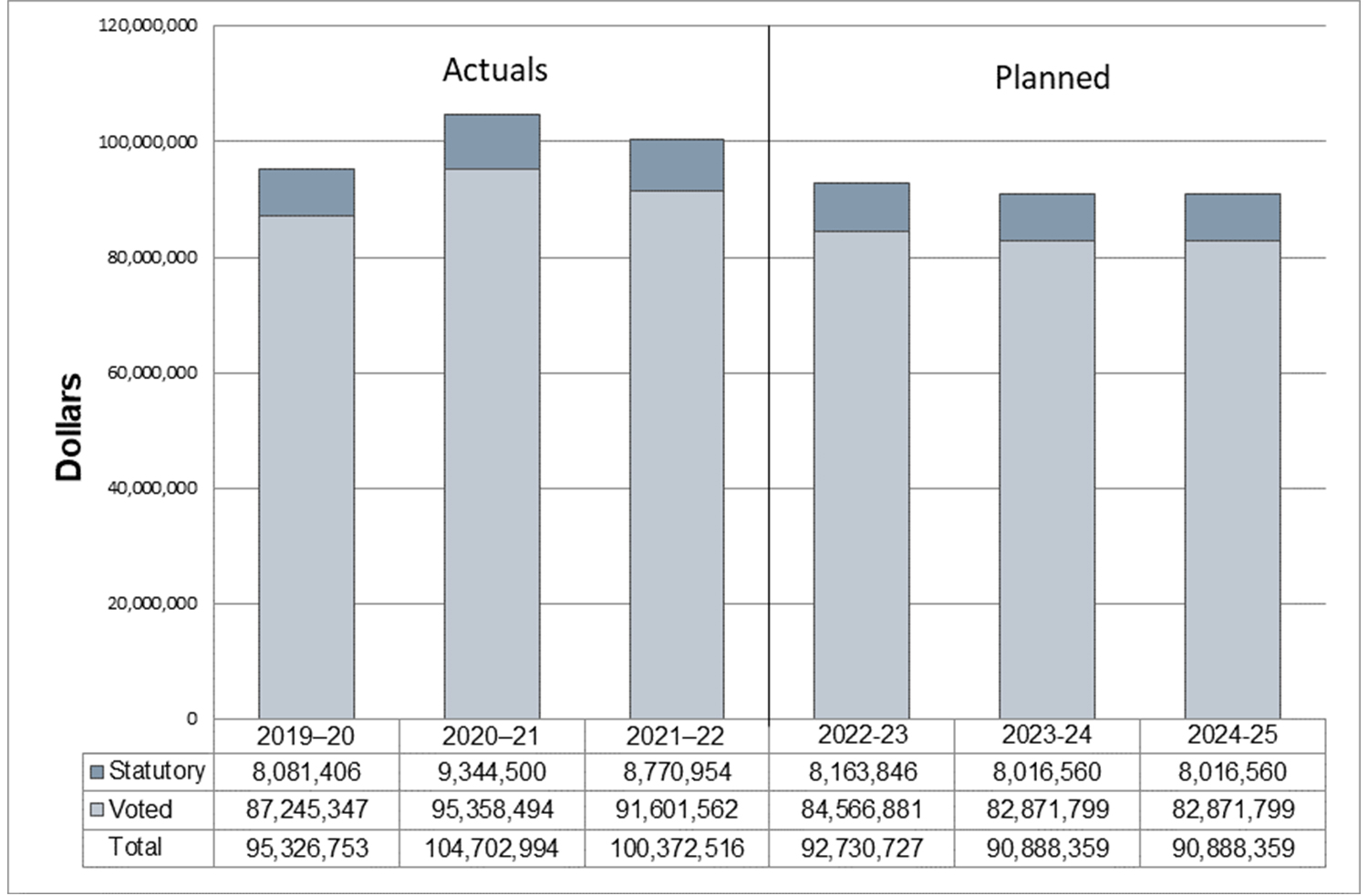
Description of the image
Departmental Spending Trend
This bar graph shows the Courts Administration Service’s total actual and planned expenditures, including statutory and voted spending, from 2018–19 to 2023–24.
- In 2019–20, voted spending was $87.2 million and statutory spending was $8.1 million. Total spending was $95.3 million.
- In 2020–21, voted spending was $95.3 million and statutory spending was $9.3 million. Total spending was $104.7 million.
- In 2021–22, voted spending of $91.6 million and statutory spending of $8.7 million are planned. Total spending is $100.3 million.
- In 2022–23, voted spending of $84.5 million and statutory spending of $8.1 million are planned. Total planned spending is $92.7 million.
- In 2023–24, voted spending of $82.8 million and statutory spending of $8 million are planned. Total planned spending is $90.8 million.
The decrease in actual spending in 2021–22 compared to 2020–21 is primarily due to the signature of new collective agreements resulting in retroactive pay payments of approximately $5 million in 2020–21 compared to $2 million in 2021–22 as well as a decrease in actual spending of $1 million related to COVID-19.
Fiscal years 2019–20 through 2021–22 included other salary-related payments for existing employee benefits such as severance and maternity pay, the option offered to employees to convert severance pay entitlements into cash, and lump-sum payments for collective agreements, which fluctuate year to year and are not included in planned spending figures for 2022–23 to 2024–25.
Budgetary performance summary for core responsibility and internal services (dollars)
The following table presents the budgetary financial resources allocated for CAS’s core responsibility and for internal services.
| Core Responsibilities and Internal Services | 2021–22 Main Estimates | 2021–22 Planned spending | 2022–23 Planned spending | 2023–24 Planned spending | 2021–22 Total authorities available for use | 2019–20 Actual spending (authorities used) | 2020–21 Actual spending (authorities used) | 2021–22 Actual spending (authorities used) |
|---|---|---|---|---|---|---|---|---|
| Administration services for the federal Courts | 67,449,968 | 67,449,968 | 66,250,825 | 64,368,077 | 83,755,765 | 67,500,680 | 75,571,641 | 67,891,005 |
| Subtotal | 67,449,968 | 67,449,968 | 66,250,825 | 64,368,077 | 83,755,765 | 67,500,680 | 75,571,641 | 67,891,005 |
| Internal Services | 26,406,075 | 26,406,075 | 26,479,902 | 26,520,282 | 27,539,290 | 27,826,073 | 29,131,353 | 32,481,511 |
| Total | 93,856,043 | 93,856,043 | 92,730,727 | 90,888,359 | 111,295,055 | 95,326,753 | 104,702,994 | 100,372,516 |
The total authorities available for use in 2021–22 were $17.4 million higher than 2021–22 planned spending. This is largely due to new funding received in both Budget 2021 and off-cycle 2020 to maintain the court system and support access to justice (COVID-19) in the amount of $8.6 million. The increase also includes the following: Budget 2021 funding received to enhance the capacity of superior courts for $3.3 million; off-cycle funding received for a CRMS for the Courts for $1.2 million; off-cycle funding received to support the delivery of justice for $0.6 million; operating budget carry-forward from 2020–21 for $2.7 million; paylist-related items for $0.7 million; and compensation for collective bargaining agreements for $0.7 million, which is offset by an adjustment to statutory authority of $0.4 million.
The variance between 2021–22 actual spending and 2021–22 planned spending is the lapse that occurred due to a combination of factors including the prolonged impacts of the pandemic, in particular supply chain issues that created delays in project delivery and affected the timing of expenditures.
Human resources
The following table presents the full-time equivalents allocated to the CAS’s core responsibility and to internal services.
| Core responsibilities and internal services | 2019–20 actual full-time equivalents |
2020–21 actual full-time equivalents |
2021–22 planned full-time equivalents |
2021–22 actual full-time equivalents |
2022–23 planned full-time equivalents |
2023–24 planned full-time equivalents |
|---|---|---|---|---|---|---|
| Administration services for the federal Courts | 559 | 568 | 567 | 562 | 561 | 546 |
| Subtotal | 559 | 568 | 567 | 562 | 561 | 546 |
| Internal Services | 197 | 185 | 183 | 193 | 183 | 183 |
| Total | 756 | 753 | 750 | 755 | 744 | 729 |
Expenditures by vote
For information on CAS’s organizational voted and statutory expenditures, consult the Public Accounts of Canada 2021.Footnote vi
Government of Canada spending and activities
Information on the alignment of CAS’s spending with the Government of Canada’s spending and activities is available in GC InfoBase.Footnote vii
Financial statements and financial statements highlights
Financial statements
CAS’s financial statements (unaudited) for the year ended March 31, 2022, are available on the departmental website https://www.cas-satj.gc.ca/en/pages/publications/dpr.Footnote viii
Financial statements highlights
| Financial information | 2021–22 Planned results | 2021–22 Actual results | 2020–21 Actual results | Difference (2021–22 Actual results minus 2021–22 Planned results) | Difference (2021–22 Actual results minus 2020–21 Actual results) |
|---|---|---|---|---|---|
| Total expenses | 125,470,393 | 130,920,683 | 132,648,308 | 5,450,290 | (1,727,625) |
| Total revenues | 4,474 | 307 | 5,334 | (4,167) | (5,027) |
| Net cost of operations before government funding and transfers | 125,465,919 | 130,920,376 | 132,642,974 | 5,454,457 | (1,722,598) |
Note:
The 2021–22 planned results are those reported in the future-Oriented Statement of OperationsFootnote ix included in the 2021–22 Departmental Plan.
Expenses: CAS’s total expenses were $130,920,683 in 2021–22 ($132,648,308 in 2020–21). The decrease of $1,727,625 (-1.30%) is mainly due to the decrease of $5,304,719 in salaries and wages offset by an increase of $3,577,094 in operating expenses.
- Salaries and employee benefits: The salaries and employee benefits expense was $74,191,494 in 2021–22 ($79,496,213 in 2020–21). The $5,304,719 (-6.67%) variance is due to decreases of $4,385,902 in salaries and wages, and $585,430 in employer contributions to employee benefit plans, both of which were a direct result of the payment of the retro pay resulting from the signature of new collective agreements in 2021–22. Other variances include: $444,001 in the provision of severance benefits, partly offset by an increase of $110,614 in employer contributions to the health and dental insurance plans (related party transaction). More than half (56.67%) of CAS’s total expenses in 2021–22 consisted of salaries and employee benefits.
- Operating: Operating expenses totalled $56,729,189 in 2021–22 ($53,152,095 in 2020–21). The $3,577,094 (6.73%) variance is mainly attributable to increases of $1,502,891 in miscellaneous expenditures, $937,877 in professional and special services, $780,013 in accommodation, $768,547 in transportation and telecommunications, $487,696 in amortization of tangible capital assets, $132,909 in printing and publishing, $82,049 in repairs and maintenance, $58,008 in rentals, and $954 in expenses incurred on behalf of Government. These increases were partly offset by decreases of $684,150 in materials and supplies, and $489,700 in machinery and equipment.
Revenues: The majority of CAS’s revenues are earned on behalf of Government. Such revenues are non-respendable, meaning that they cannot be used by CAS, and are deposited directly into the Consolidated Revenue Fund (CRF). CAS earns a small amount of respendable revenue from the sale of Crown assets. CAS’s gross revenues were $2,397,611 in 2021–22 ($1,927,736 in 2020–21) and its net revenues were $307 in 2021–22 ($5,334 in 2020–21).
| Financial information | 2021–22 | 2020–21 | Difference (2021–22 minus 2020–21) |
|---|---|---|---|
| Total net liabilities | 24,370,814 | 24,540,516 | (169,702) |
| Total net financial assets | 19,847,492 | 17,500,552 | 2,346,940 |
| Departmental net debt | 4,523,322 | 7,039,964 | (2,516,642) |
| Total non-financial assets | 29,164,849 | 27,516,039 | 1,648,810 |
| Departmental net financial position | 24,641,527 | 20,476,075 | 4,165,452 |
Note:
Total liabilities: CAS’s net liabilities as at March 31, 2022 were $24,370,814 ($24,540,516 as at March 31, 2021). The decrease of $169,702 (-1%) is the result of the following:
- Accounts payable and accrued liabilities (46.61% of total liabilities): Decrease of $253,642 includes a decrease of $1,742,499 in accounts payable to other government departments and agencies and of $219,801 in accrued liabilities related to salaries and wages. Decrease offset by an increase of $1,708,658 in accounts payable to external parties.
- Vacation pay and compensatory leave (18.11% of total liabilities): Decrease of $346,147 includes a decrease of $388,193 in vacation pay allowance, partly offset by an increase of $42,046 in compensatory leave allowance.
- Deposit accounts (28.77% of total liabilities): Increase of $939,768 in deposit accounts reflects many separate decisions of the Courts. Deposits cannot be projected and the balance in the deposit accounts can vary significantly from year to year.
- Employee future benefits (6.51% of total liabilities): Decrease of $509,681 due to a decrease in the severance benefit liability.
Assets: The composition of CAS’s financial and non-financial assets is as follows:
Financial assets:
- Due from the CRF (33.76% of gross assets)
Non-financial assets:
- Tangible capital assets (55.92% of gross assets)
- Inventory (1.39% of gross assets)
- Prepaid expenses (2.20% of gross assets)
Total net financial assets: This is comprised of financial assets net of accounts receivable held on behalf of Government. Accounts receivable held on behalf of the Government of Canada consist primarily of accounts receivable from other governmental organizations. The increase of $2,346,940 is mainly due to an increase in the accounts receivable and advances and amount due from the CRF.
Total non-financial assets: The increase of $1,648,810 is mainly due to an increase of $1,996,131 in tangible capital assets related to facilities renovation projects, informatics and e-courtroom purchases and installation of informatics equipment. This increase is partly offset by a decrease of $242,491 in inventory and $104,830 in prepaid expenses.
Departmental net debt: This provides a measure of the future authorities required to pay for past transactions and events.
Departmental net financial position: This represents the net resources (financial and non-financial) that will be used to provide future services to the Courts and thereby to benefit Canadians.
The 2021–22 planned results information is provided in CAS’s Future-Oriented Statement of Operations, as well as the Notes to that statement.Footnote x
Corporate information
Organizational profile
Appropriate minister: The Honourable David Lametti, Q.C., P.C., M.P.
Institutional head: Darlene H. Carreau, Chief Administrator
Ministerial portfolio: Justice
Enabling instrument(s): Courts Administration Service Act, S.C. 2002, c. 8Footnote xi
Year of incorporation / commencement: 2003
Mandate and role: who we are and what we do
Information on CAS’s mandate and role is available on CAS’s website.Footnote xii
For more information on the department’s organizational mandate letter commitments, see the
Minister’s mandate letter.Footnote xiii
Operating context
Information on the operating context is available on the CAS’s website.Footnote xiv
Reporting framework
CAS’s Departmental Results Framework and Program Inventory of record for 2021–22 are shown below.
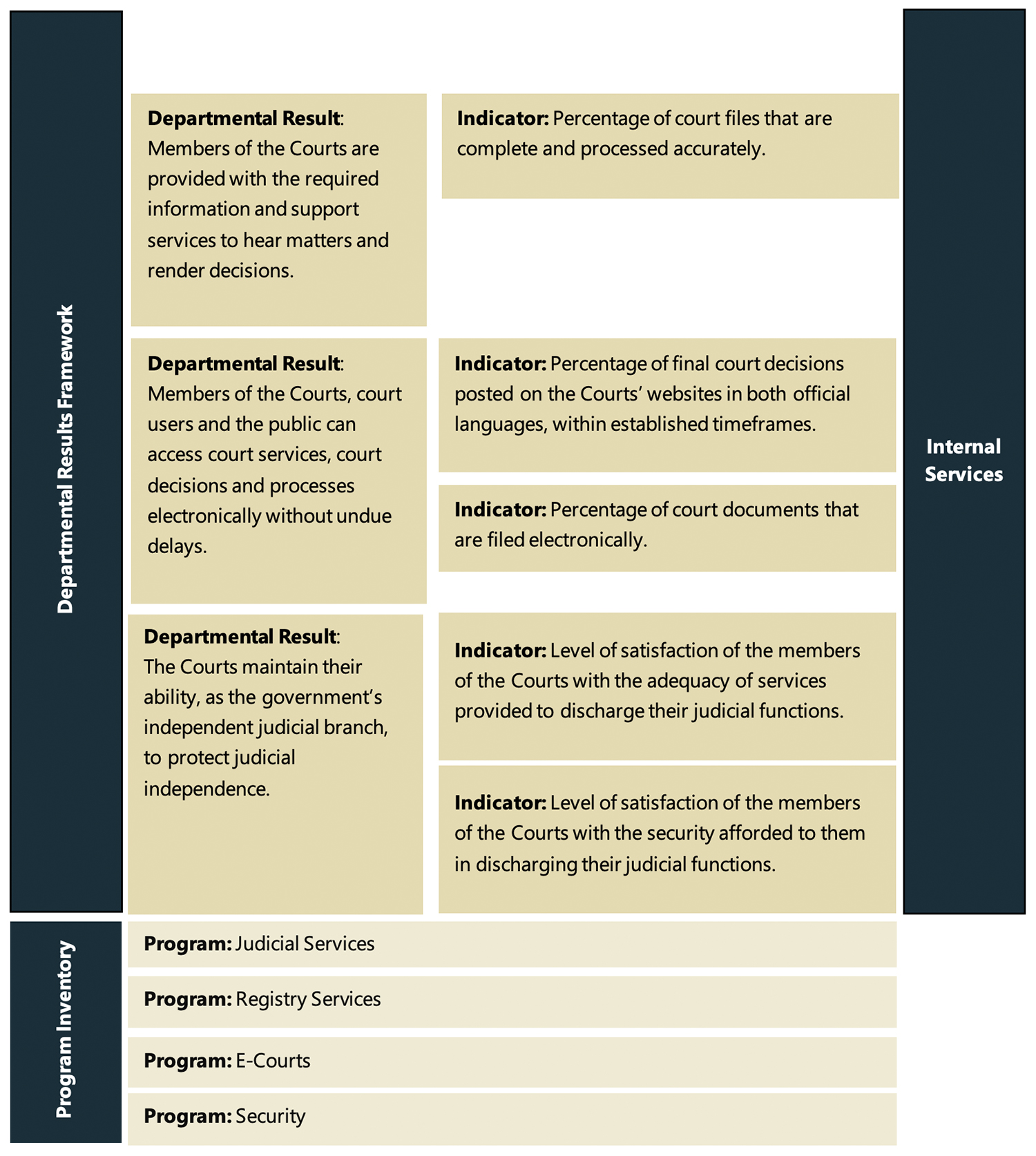
Description of the image
Departmental Results Framework
Departmental Result: Members of the Courts are provided with the required information and support services to hear matters and render decisions.
Indicator: Percentage of court files that are complete and processed accurately.
Departmental Result: Members of the Courts, court users and the public can access court services, court decisions and processes electronically without undue delays.
Indicator: Percentage of final court decisions posted on the Courts’ websites in both official languages, within established timeframes.
Indicator: Percentage of court documents that are filed electronically.
Departmental Result:
The Courts maintain their ability, as the government’s independent judicial branch, to protect judicial independence.
Indicator: Level of satisfaction of the members of the Courts with the adequacy of services provided to discharge their judicial functions.
Indicator: Level of satisfaction of the members of the Courts with the security afforded to them in discharging their judicial functions.
Internal Services
Program Inventory
Program: Judicial Services
Program: Registry Services
Program: E-Courts
Program: Security
Supporting information on the Program Inventory
Financial, human resources and performance information for CAS’s Program Inventory is available in CAS’s program inventory is available in the GC InfoBase.Footnote xv
Supplementary information tables
The following supplementary information tables are available on CAS’s website https://www.cas-satj.gc.ca/en/pages/publications/dpr.Footnote xvi
- Departmental Sustainable Development Strategy/Reporting on Green Procurement
- Gender-based analysis plus
- Response to parliamentary committees and external audits
Federal tax expenditures
The tax system can be used to achieve public policy objectives through the application of special measures such as low tax rates, exemptions, deductions, deferrals and credits. The Department of Finance Canada publishes cost estimates and projections for these measures each year in Report on Federal Tax Expenditures.Footnote xvii This report also provides detailed background information on tax expenditures, including descriptions, objectives, historical information and references to related federal spending programs as well as evaluations and GBA Plus Plus of tax expenditures.
Organizational contact information
Mailing address:
Courts Administration Service
90 Sparks Street
Ottawa, Ontario K1A 0H9
Canada
Email: Info@cas-satj.gc.ca
Website: https://www.cas-satj.gc.ca
Appendix: definitions
- appropriation (crédit)
- Any authority of Parliament to pay money out of the Consolidated Revenue Fund.
- budgetary expenditures (dépenses budgétaires)
- Operating and capital expenditures; transfer payments to other levels of government, organizations or individuals; and payments to Crown corporations.
- core responsibility (responsabilité essentielle)
- An enduring function or role performed by a department. The intentions of the department with respect to a core responsibility are reflected in one or more related departmental results that the department seeks to contribute to or influence.
- Departmental Plan (plan ministériel)
- A report on the plans and expected performance of an appropriated department over a 3 year period. Departmental Plans are usually tabled in Parliament each spring.
- departmental priority (priorité ministérielle)
- A plan or project that a department has chosen to focus and report on during the planning period. Priorities represent the things that are most important or what must be done first to support the achievement of the desired departmental results.
- departmental result (résultat ministériel)
- A consequence or outcome that a department seeks to achieve. A departmental result is often outside departments’ immediate control, but it should be influenced by program-level outcomes.
- departmental result indicator (indicateur de résultat ministériel)
- A quantitative measure of progress on a departmental result.
- departmental results framework (cadre ministériel des résultats)
- A framework that connects the department’s core responsibilities to its departmental results and departmental result indicators.
- Departmental Results Report (rapport sur les résultats ministériels)
- A report on a department’s actual accomplishments against the plans, priorities and expected results set out in the corresponding Departmental Plan.
- experimentation (expérimentation)
- The conducting of activities that seek to first explore, then test and compare the effects and impacts of policies and interventions in order to inform evidence-based decision-making, and improve outcomes for Canadians, by learning what works, for whom and in what circumstances. Experimentation is related to, but distinct from innovation (the trying of new things), because it involves a rigorous comparison of results. For example, using a new website to communicate with Canadians can be an innovation; systematically testing the new website against existing outreach tools or an old website to see which one leads to more engagement, is experimentation.
- full time equivalent (équivalent temps plein)
- A measure of the extent to which an employee represents a full person year charge against a departmental budget. For a particular position, the full time equivalent figure is the ratio of number of hours the person actually works divided by the standard number of hours set out in the person’s collective agreement.
- gender-based analysis plus (GBA Plus) (analyse comparative entre les sexes plus [ACS Plus])
- An analytical tool used to support the development of responsive and inclusive policies, programs and other initiatives; and understand how factors such as sex, race, national and ethnic origin, Indigenous origin or identity, age, sexual orientation, socio-economic conditions, geography, culture and disability, impact experiences and outcomes, and can affect access to and experience of government programs.
- government-wide priorities (priorités pangouvernementales)
- For the purpose of the 2021–22 Departmental Results Report, government-wide priorities refers to those high-level themes outlining the government’s agenda in the 2020 Speech from the Throne, namely: Protecting Canadians from COVID-19; Helping Canadians through the pandemic; Building back better – a resiliency agenda for the middle class; The Canada we’re fighting for.
- horizontal initiative (initiative horizontale)
- An initiative where two or more federal organizations are given funding to pursue a shared outcome, often linked to a government priority.
- non-budgetary expenditures (dépenses non budgétaires)
- Net outlays and receipts related to loans, investments and advances, which change the composition of the financial assets of the Government of Canada.
- performance (rendement)
- What an organization did with its resources to achieve its results, how well those results compare to what the organization intended to achieve, and how well lessons learned have been identified.
- performance indicator (indicateur de rendement)
- A qualitative or quantitative means of measuring an output or outcome, with the intention of gauging the performance of an organization, program, policy or initiative respecting expected results.
- performance reporting (production de rapports sur le rendement)
- The process of communicating evidence based performance information. Performance reporting supports decision making, accountability and transparency.
- plan (plan)
- The articulation of strategic choices, which provides information on how an organization intends to achieve its priorities and associated results. Generally, a plan will explain the logic behind the strategies chosen and tend to focus on actions that lead to the expected result.
- planned spending (dépenses prévues)
- For Departmental Plans and Departmental Results Reports, planned spending refers to those amounts presented in Main Estimates.
A department is expected to be aware of the authorities that it has sought and received. The determination of planned spending is a departmental responsibility, and departments must be able to defend the expenditure and accrual numbers presented in their Departmental Plans and Departmental Results Reports. - program (programme)
- Individual or groups of services, activities or combinations thereof that are managed together within the department and focus on a specific set of outputs, outcomes or service levels.
- program inventory (répertoire des programmes)
- Identifies all the department’s programs and describes how resources are organized to contribute to the department’s core responsibilities and results.
- result (résultat)
- A consequence attributed, in part, to an organization, policy, program or initiative. Results are not within the control of a single organization, policy, program or initiative; instead, they are within the area of the organization’s influence.
- statutory expenditures (dépenses législatives)
- Expenditures that Parliament has approved through legislation other than appropriation acts. The legislation sets out the purpose of the expenditures and the terms and conditions under which they may be made.
- target (cible)
- A measurable performance or success level that an organization, program or initiative plans to achieve within a specified time period. Targets can be either quantitative or qualitative.
- voted expenditures (dépenses votées)
- Expenditures that Parliament approves annually through an appropriation act. The vote wording becomes the governing conditions under which these expenditures may be made.
- Date modified: