
Departmental Results Report 2020-21
The Departmental Results Report (DRR) is published in PDF and HTML formats.
The Honourable David Lametti, Q.C., P.C., M.P.
Minister of Justice and Attorney General of Canada
Table of Contents
Analysis of trends in spending and human resources
- Actual expenditures
- Actual human resources
- Expenditures by vote
- Government of Canada spending and activities
- Financial statements and financial statements highlights
- Organizational profile
- Raison d’être, mandate and role: who we are and what we do
- Operating context
- Reporting Framework
Supporting information on the Program Inventory
Supplementary information tables
Organizational contact information
From the Chief Administrator
It is my pleasure to present the Courts Administration Service 2020–21 Departmental Results Report. The report highlights the achievements of the Courts Administration Service (CAS) over the past fiscal year providing judicial, registry, court security and electronic court services to the Federal Court of Appeal (FCA), Federal Court (FC), Court Martial Appeal Court of Canada (CMAC) and Tax Court of Canada (TCC)—collectively referred to as the “Courts”—in support of the delivery of justice to all Canadians.
The past year presented significant challenges to court operations and court administrations worldwide. Due to the extraordinary circumstances presented by the COVID-19 pandemic, CAS staff rethought how to deliver our services, perform our work, and serve the Courts and Canadians. I am immensely proud of CAS and all its employees who provided timely, innovative and effective services, both virtually and in-person throughout the pandemic, while at the same time turning these challenges into unique opportunities for improved service delivery.
Our work made certain the Courts remained open during the pandemic and positively contributed to Canada’s justice system by ensuring continued access to justice for all Canadians. We implemented robust, multi-layered health and safety measures in all our court facilities and courtrooms across Canada to safely support in-person appearances, and delivered digital solutions for the conduct of virtual and hybrid hearings. Providing uninterrupted access to justice throughout the pandemic is a testament to our highly skilled and talented employees' exemplary dedication, resilience, and agility.
Our accomplishments last fiscal year also served as important catalysts to modernize our procedures and processes and integrate new business and technological solutions to better serve the Courts and Canadians. During the year, the move to virtual operations accelerated the implementation of information technology infrastructure, and systems were crucial for digital courts and the electronic management of court business. E-court capacity was expanded, the e-filing capabilities of the Courts were enhanced and the digitization of Court documents was accelerated. The multi-year project to implement a new digital Courts and Registry Management System (CRMS) advanced but not as quickly as expected, extra attention will be required in the coming year; four new fully digitally equipped courtrooms were built and plans to construct a modern, equipped and accessible federal courthouse in Montréal progressed. The lessons learned will help us seize future opportunities to further modernize and improve access to justice in the future.
The pandemic has indelibly marked judicial administration, and there is a tremendous opportunity for us to significantly and thoughtfully transform our services to the Courts and Canadians. Looking to the future, we will build on the innovations we implemented in response to the pandemic as we move forward with sustainable solutions that address some of the longstanding challenges in the justice system. Providing consistent, efficient, quality, and timely client-centric services will remain our primary focus to serve the Courts with excellence and support the delivery of justice for all Canadians.
I am grateful for the close collaboration of the Chief Justices, the Associate Chief Justices, and all members of the Courts, whose partnership is instrumental to our continued success.
Darlene H. Carreau LL.B.
Chief Administrator
Results at a glance
In 2020–21, CAS’s efforts were focused on four key areas: pandemic management, digital courts and virtual hearings, our workforce, and national court facilities and courtrooms. The following are key results achieved during the fiscal year in each of these areas.
| Area | Results Achieved |
|---|---|
|
Pandemic Management |
|
|
Digital Courts and Virtual Hearings |
|
|
Our Workforce |
|
|
National Court Facilities and Courtrooms |
|
| Total actual spending for 2020–21: $104,702,994 |
Total actual full-time equivalents for 2020–21: 753 |
For more information on the CAS’s plans, priorities and results achieved, “Results: what we achieved” section of this report.
Results: what we achieved
Core responsibility
Administration services for the federal Courts
Description
Provide timely and efficient judicial, registry, court security and electronic court services to the FCA, the FC, the CMAC and the TCC; coordinate and balance the provision of services among the four Courts; and safeguard the independence of the Courts by placing administrative services at arm’s length from the Government of Canada.
Results
The following outlines the key results that CAS achieved in 2020–21 to support its core responsibility and the organization’s departmental results. First and foremost, CAS continued to innovate to offer quality, timely services that are responsive to the evolving needs of the Courts and those that appear before them, ultimately providing improved access to justice for all Canadians.
Pandemic management
The COVID-19 pandemic significantly affected the Courts and CAS’s operations during 2020–21. CAS adapted its service delivery model to best support the Courts given the risks posed by the pandemic and the public health restrictions in effect across the country. CAS’s response to COVID-19 involved implementing a multi-layered health and safety approach in all court facilities and courtrooms across Canada, utilizing a combination of mitigation strategies concurrently. These measures safeguarded the health of everyone entering our facilities and courthouses while ensuring access to justice and continuing court operations as effectively and as efficiently as possible. Many employees across the country worked on-site to ensure the Courts remained operational and resilient throughout. These efforts ensured the Courts could safely conduct in-person hearings and proceedings, as required throughout the pandemic.
CAS established measures to mitigate the potential transmission of COVID-19 and protect those working or accessing court services and court facilities and courtrooms in-person. Across the country, protective barriers were added in courtrooms and in workspaces where physical distancing was not possible, cleaning of facilities and courtrooms was enhanced, and personal protective equipment was distributed to employees and those accessing court or registry services. These measures reflected the requirements of applicable federal, provincial, and territorial occupational health and safety legislation to minimize the risk of introducing, transmitting and spreading the virus. They also aligned with the expert health advice received from the Public Health Agency of Canada; best practices and guidelines of the Action Committee on Court Operations in Response to COVID-19; as well as advice and guidance from Treasury Board Secretariat and the Office of the Chief Human Resources Officer for the Government of Canada. An independent firm conducted site visits in Ottawa and all regional offices to validate these measures.
COVID-19 preventative measures adopted by CAS
- Installation of protective barriers in courtrooms and court facilities
- Signage and floor markers to promote physical distancing
- Mandatory requirement to use blue disposable procedural masks at all times, including in the courtroom, unless directed otherwise by the presiding judge
- Occupancy limits in operational and public zones
- Indoor air quality monitoring
- Enhanced court screening procedures for COVID-19
- Enhanced cleaning and sanitization of courtrooms and surrounding areas following each hearing
Comprehensive guidance on the application of preventative measures and protocols was drafted. A COVID-19 workplace preventative measures guide was distributed to managers and employees. A guide for in-person court operations was also published on the CAS website. This guide outlined the procedures and protocols that apply to all members of the public attending in-person hearings or visiting the registry counter.
The COVID-19 preventative measures adopted by CAS were actively monitored and adjusted continuously in keeping with the evolution of the pandemic and the latest advice from public health agencies across Canada. Modifications were also reflected in the guidance documents to provide managers, employees and the public with the most current guidance and information.
Digital courts and virtual hearings
CAS pivoted to operating virtually in 2020–21, with the majority of employees successfully working and providing services through various digital means. In addition, CAS supported the Courts to prepare for and conduct hearings, case management, settlement conferences and other matters virtually.
54% of all court documents were filed electronically in 2020–21.
Laptops, mobile phones, related accessories and software were distributed to employees to enable productivity in a digital environment and facilitate remote work. IT infrastructure was increased to accommodate virtual operations, and platforms such as MS Teams and Zoom were implemented to allow employees across the organization to communicate and collaborate virtually.
Several initiatives were undertaken to deliver IT solutions to the Courts, legal counsel and litigants that facilitated the digital management of court business. The electronic submission of court documents was enhanced with the release of a new e-filing portal on the FC website and improvements made to the TCC’s e-filing portal. An online payment option was also introduced as part of the FC e-filing. We also expanded our e-trial toolkit and implemented the use of SharePoint to allow litigants and the Courts to share and access digital court files, including during virtual proceedings.
The Courts' capacity to accommodate virtual hearings and trials was also expanded. Two new fully digital e-courtrooms were constructed in Ottawa for the FC and CMAC, and several upgrades were made to facilitate the integration of digital audio equipment in courtrooms. Wi-Fi was installed at each of the four Courts and CAS headquarters in Ottawa. A planned second phase, to permit access for guest and personal devices in court facilities and courtrooms, was delayed due to COVID-19.
E-courtrooms are equipped with integrated IT infrastructure to support virtual hearings and trials, including video conferencing, digital screens, computer workstations, internet connectivity, and digital audio recording systems.
The multi-year project to implement a new digital CRMS continued with a focus on preparatory work to define system requirements and activate the procurement process. A request for information from the industry identified risks particularly as concerns bilingualism. To respond to these risks, CAS will review the planned procurement strategy, as well as reassess the project’s schedule and budget.
The digitization of incoming court documents was prioritized with active and priority files at the TCC converted to digital format. CAS also assisted CMAC and the TCC with redesigning and reconfiguring their public-facing websites with new user-friendly interfaces and updated content. As well, a second release of the FC’s Electronic Judicial Calendar containing additional functionally was completed to assist with managing the scheduling of proceedings and the assignment of members of the Court.
Our workforce
In 2020–21, CAS also advanced its priority to build an innovative, agile and high-performing organization to best support the evolving requirements of the Courts and Canadians. The initiative to modernize the registries’ operational training model advanced with the help of a project steering committee established to lead the effort. Furthermore, the training strategy for the FC was initiated, and CAS worked to document the current learning path and to determine future learning requirements for a new CRMS.
A new learning management system was introduced for CAS. This system allows employees to manage their learner files autonomously. The first phase of the launch enabled employees to track all courses related to mandatory training required for their position. Additional functionality in subsequent updates will allow employees to tailor learning and development to their career paths and aspirations.
National court facilities and courtrooms
Facilities projects and plans were challenging during COVID-19, given public health restrictions and global supply chain issues. Additionally, it was necessary to prioritize efforts to ensure our court facilities and courtrooms across Canada remained safe to protect those working or accessing services in-person. Nevertheless, several projects were completed to ensure national court facilities and courtrooms are modernized, equipped, secure and accessible.
In Ottawa, new judicial chambers for the FC were built, and three new courtrooms, including two e-courtrooms, were constructed for the FC and CMAC. CAS acquired and established additional office space for the TCC in Ottawa to accommodate registry and judicial employees, ensuring appropriate physical distancing for those working on-site. The Calgary court facilities were renovated to improve the security posture and accessibility in our courtrooms and at the registry counter.
In addition, CAS worked during the fiscal year to determine the long-term facilities requirements of the Courts to ensure they have the requisite capacity and national presence to offer the level of services required by Canadians across the country. An analysis was also conducted to inform the prioritization of funding for projects identified in our National Accommodations Strategic Plan. CAS collaborated with Public Services and Procurement Canada to plan the construction of a state-of-the-art federal courthouse in Montréal by 2027 and participated in a national working group established to review the future of the judicial precinct area in the National Capital Region.
Gender-based analysis plus (GBA Plus)
CAS is committed to the full implementation of GBA Plus in the development of policies, programs and initiatives, including consideration of differentiated impacts on diverse groups of women and men. Further information on GBA Plus is available on the CAS website.Footnote i
Key corporate risks
For 2020–21, CAS developed a Corporate Risk Profile, which identifies the organization’s key risks, demonstrates how they are tied to CAS’s core responsibility and priorities, and categorizes the risk response strategies to be implemented. Further information on key risks is available on the CAS website.Footnote ii
| Departmental result | Departmental result indicator | Target | Date to achieve target |
2018–19 actual result |
2019–20 actual result |
2020–21 actual result |
|---|---|---|---|---|---|---|
| Members of the Courts are provided with the required information and support services to hear matters and render decisions. | Percentage of court files that are complete and processed accurately. | Exactly 100% | March 31, 2021 | 92%* | 92.5%* | 94%* |
| Members of the Courts, court users and the public can access court services, court decisions and processes electronically without undue delays. | Percentage of final court decisions posted on the Courts’ websites in both official languages, within established timeframes. | At least 95% | March 31, 2021 | 93% | 92% | 80%** |
| Percentage of court documents that are filed electronically. | At least 80% | March 31, 2021 | 23%† | 26.5%† | 54%† | |
| The Courts maintain their ability, as the government’s independent judicial branch, to protect judicial independence. | Level of satisfaction of the members of the Courts with the adequacy of services provided to discharge their judicial functions. | At least a rating of 4 on a scale of 1–5 | March 31, 2021 | Not evaluatedΩ | Not evaluated‡ | Not evaluated‡ |
| Level of satisfaction of the members of the Courts with the security afforded to them in discharging their judicial functions. | At least a rating of 4 on a scale of 1–5 | March 31, 2021 | Not evaluatedΩ | Not evaluated‡ | Not evaluated‡ |
*Represents the average for the FCA and FC. Results are not included for the CMAC as the sample size is too small to be statistically significant. The TCC does not track performance data for this indicator. ↩
**The percentage is lower than in previous years due to a high volume of court decisions to be translated, in addition to system limitations that affected the posting of decisions.↩
†Represents the average of court documents filed electronically across the Courts. ↩
Ω Measurement of these departmental results indicators were deferred. ↩
‡Measurement of these departmental results indicators were postponed due to the COVID-19 pandemic.↩
| 2020–21 Main Estimates |
2020–21 Planned spending |
2020–21 Total authorities available for use |
2020–21 Actual spending (authorities used) |
2020–21 Difference (Actual spending minus Planned spending) |
|---|---|---|---|---|
| 65,906,281 | 65,906,281 | 81,208,658 | 75,571,641 | 9,665,360 |
| 2020–21 Planned full-time equivalents |
2020–21 Actual full-time equivalents |
2020–21 Difference (Actual full-time equivalents minus Planned full-time equivalents) |
|---|---|---|
| 566 | 568 | 2 |
Financial, human resources and performance information for the CAS’s Program Inventory is available in GC InfoBase.Footnote iii
Internal Services
Description
Internal Services are those groups of related activities and resources that the federal government considers to be services in support of programs and/or required to meet corporate obligations of an organization. Internal Services refers to the activities and resources of the 10 distinct service categories that support Program delivery in the organization, regardless of the Internal Services delivery model in a department. The 10 service categories are:
- Acquisition Management Services
- Communications Services
- Financial Management Services
- Human Resources Management Services
- Information Management Services
- Information Technology Services
- Legal Services
- Materiel Management Services
- Management and Oversight Services
- Real Property Management Services
Results
The COVID-19 pandemic led to unexpected challenges and opportunities that necessitated a rapid shift in service delivery, business processes and work environment. Since many employees had not worked remotely before the pandemic, CAS offered training and online resources throughout the year to help employees adapt and succeed. Specialized training and resources were made available to managers to help them effectively support their teams in a work environment affected by the pandemic.
Mental health remained a priority in 2020–21 and gained increased importance with the pandemic. As a result, several training courses, information sessions, newsletters, and bulletins on improving mental health, dealing with stress in a healthy way, self-care practices, and being resilient, were delivered to employees. In addition, virtual events were organized to promote mental health, such as online meditation and check-in sessions. CAS also provided advice and guidance to managers to help them identify the signs of mental health and engage in an open dialogue with employees.
A Mental Health Calendar was launched on the CAS Intranet providing employees with choices of events, training, and services offered monthly to promote mental health and wellbeing.
Several Canadian and worldwide events in 2020–21 shed light on systemic racism and its effects on racialized and marginalized individuals. Following engagement and dialogue with employees, an anti-racism champion was appointed, and CAS developed and implemented FACES: Anti-Racism Strategy 2020-2025. This strategy outlines the organization’s commitment to addressing systemic racism, unconscious biases and other forms of discrimination. In support of the strategy’s implementation, a Chief Administrator Anti-Racism Consultation and Action Committee was established. Additionally, CAS made advancements in developing a diversity and inclusion plan to foster a representative workforce reflective of the Canadian population.
Our Anti-racism Strategy is entitled FACES as it aims to promote the multitude of diverse “faces” within CAS.
CAS proceeded with the implementation of recommendations from the comprehensive national threat and risk assessment completed in 2019–20. Work was also initiated to develop a multi-year strategic plan for CAS. This plan will be an integral tool in helping to shape our service and business transformation. It will guide efforts to provide innovative, timely and efficient services that are responsive to the evolving needs of the Courts and those that appear before them, ultimately improving access to justice for all Canadians. During the fiscal year, consultations with the Courts and senior managers from the organization's key business areas were conducted to define the plan's scope, objective, and critical initiatives. The strategic plan will be further refined and finalized over the next fiscal year and, once approved, will be implemented for 2021–26.
| 2020–21 Main Estimates |
2020–21 Planned spending |
2020–21 Total authorities available for use |
2020–21 Actual spending (authorities used) |
2020–21 Difference (Actual spending minus Planned spending) |
|---|---|---|---|---|
| 26,962,208 | 26,962,208 | 30,934,838 | 29,131,353 | 2,169,145 |
| 2020–21 Planned full-time equivalents |
2020–21 Actual full-time equivalents |
2020–21 Difference (Actual full-time equivalents minus Planned full-time equivalents) |
|---|---|---|
| 198 | 185 | (13) |
Analysis of trends in spending and human resources
Actual expenditures
Departmental spending trend graph
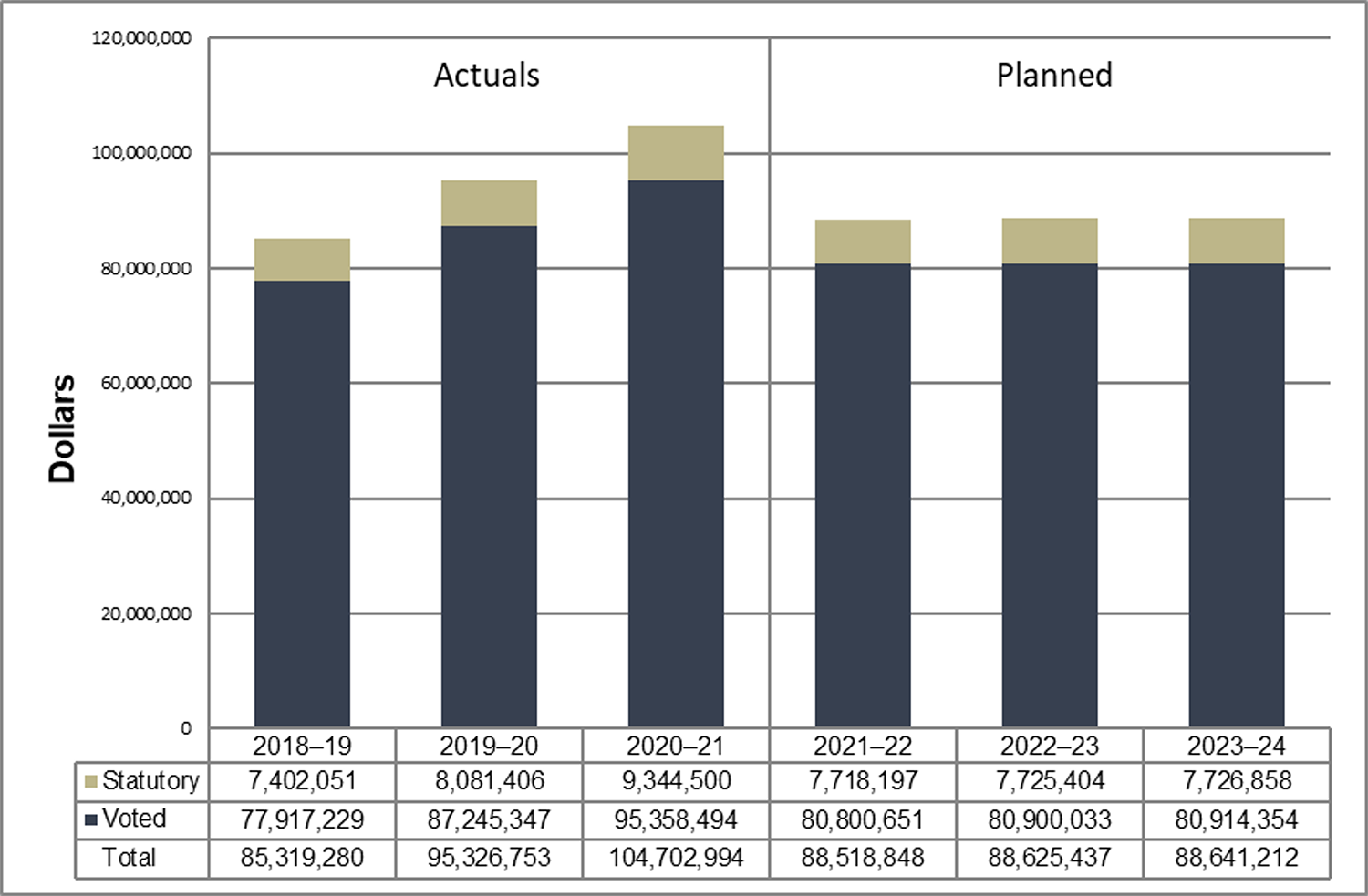
The following graph presents planned (voted and statutory) spending over time.
Description of the image
Departmental Spending Trend
This bar graph shows the Courts Administration Service’s total actual and planned expenditures, including statutory and voted spending, from 2018–19 to 2023–24.
- In 2018–19, voted spending was $77.9 million and statutory spending was $7.4 million. Total spending was $85.3 million.
- In 2019–20, voted spending was $87.2 million and statutory spending was $8.1 million. Total spending was $95.3 million.
- In 2020–21, voted spending was $95.3 million and statutory spending was $9.3 million. Total spending was $104.7 million.
- In 2021–22, voted spending of $80.8 million and statutory spending of $7.7 million are planned. Total planned spending is $88.5 million.
- In 2022–23, voted spending of $80.9 million and statutory spending of $7.7 million are planned. Total planned spending is $88.6 million.
- In 2023–24, voted spending of $80.9 million and statutory spending of $7.7 million are planned. Total planned spending is $88.6 million.
Note:
The increase in actual spending in 2020–21 is primarily due to off-cycle funding received for Restarting the Court System and Supporting Access to Justice (COVID-19) as well as funding received in compensation for collective bargaining and payments for Phoenix damages.
Fiscal years 2018–19 through 2020–21 included other salary-related payments for existing employee benefits such as severance and maternity pay, the option offered to employees to convert severance pay entitlements into cash, and lump sum payments for collective agreements, which fluctuate year to year and are not included in planned spending figures for 2021–22 to 2023–24.
Budgetary performance summary for Core Responsibilities and Internal Services (dollars)
| Core Responsibilities and Internal Services | 2020–21 Main Estimates | 2020–21 Planned spending | 2021–22 Planned spending | 2022–23 Planned spending | 2020–21 Total authorities available for use | 2018–19 Actual spending (authorities used) | 2019–20 Actual spending (authorities used) | 2020–21 Actual spending (authorities used) |
|---|---|---|---|---|---|---|---|---|
| Administration Services for the Federal Courts | 65,906,281 | 65,906,281 | 62,408,246 | 62,435,273 | 81,208,658 | 59,886,541 | 67,500,680 | 75,571,641 |
| Subtotal | 65,906,281 | 65,906,281 | 62,408,246 | 62,435,273 | 81,208,658 | 59,886,541 | 67,500,680 | 75,571,641 |
| Internal Services | 26,962,208 | 26,962,208 | 26,110,602 | 26,190,164 | 30,934,838 | 25,432,739 | 27,826,073 | 29,131,353 |
| Total | 92,868,489 | 92,868,489 | 88,518,848 | 88,625,437 | 112,143,496 | 85,319,280 | 95,326,753 | 104,702,994 |
Note:
The total authorities available for use in 2020–21 were $19.3 million higher than 2020–21 planned spending. This is due to funding received for Supporting the Delivery of Justice Through the Courts Administration Service $2.4 million. The increase also includes the following: off-cycle funding received for a CRMS for the Courts for the amount of $2.5 million; Restarting the Court System and Supporting Access to Justice (COVID-19) of $5.7 million; operating budget carry forward from 2019–20 for $2.1 million; paylist-related items for $0.7 million; Compensation for collective bargaining agreements for $5.0 million; and Statutory authority for $0.9 million. The variance between 2020–21 total authorities and 2020–21 actual spending is the lapse that occurred due to combination of factors, mainly delays in project delivery and timing of expenditures.
Actual human resources
| Core Responsibilities and Internal Services | 2018–19 Actual full-time equivalents |
2019–20 Actual full-time equivalents |
2020–21 Planned full-time equivalents |
2020–21 Actual full-time equivalents |
2021–22 Planned full-time equivalents |
2022–23 Planned full-time equivalents |
|---|---|---|---|---|---|---|
| Administration Services for the Federal Courts | 510 | 559 | 566 | 568 | 553 | 553 |
| Subtotal | 510 | 559 | 566 | 568 | 553 | 553 |
| Internal Services | 168 | 197 | 198 | 185 | 195 | 195 |
| Total | 678 | 756 | 764 | 753 | 748 | 748 |
Note:
The variance in the Actuals full-time equivalents (FTE’s) in 2020–21 compared to 2019–20 is minor and can be explained by the turnover in staff and staffing delays. Planned FTE’s in 2021–22 and future years are lower as a result of sunsetting funding.
Expenditures by vote
For information on the Courts Administration Service’s organizational voted and statutory expenditures, consult the Public Accounts of Canada 2020–2021.Footnote iv
Government of Canada spending and activities
Information on the alignment of the Courts Administration Service’s spending with the Government of Canada’s spending and activities is available in GC InfoBase.Footnote v
Financial statements and financial statements highlights
Financial statements
The Courts Administration Service’s financial statements (unaudited) for the year ended March 31, 2021, are available on the departmental website.Footnote vi
Financial statements highlights
| Financial information | 2020–21 Planned results | 2020–21 Actual results | 2019–20 Actual results | Difference (2020–21 Actual results minus 2020–21 Planned results) | Difference (2020–21 Actual results minus 2019–20 Actual results) |
|---|---|---|---|---|---|
| Total expenses | 123,507,021 | 132,648,308 | 125,225,550 | 9,141,287 | 7,422,758 |
| Total revenues | 3,111 | 5,334 | 3,376 | 2,223 | 1,958 |
| Net cost of operations before government funding and transfers | 123,503,910 | 132,642,974 | 125,222,174 | 9,139,064 | 7,420,800 |
Note:
The 2020–21 planned results are those reported in the future-oriented statement of operationsFootnote vii included in the 2020–21 Departmental Plan.
Expenses: CAS’s total expenses were $132,648,308 in 2020–21 ($125,225,550 in 2019–20). The largest components of the increase of $7,422,758 (5.93%) were mainly increases in salaries and wages, transportation and telecommunication, and materials and supplies. This increase in expenditures was the result of an increase in funding for the following initiatives: $5,500,849 in off-cycle funding received for Restarting the Court System and Supporting Access to Justice (COVID-19) and $4,948,583 in compensation for collective bargaining and payments for Phoenix damages. The increase also includes: $2,310,604 in new funding for the delivery of justice through the CAS; $800,000 in program integrity funding; $430,776 for CRMS; $1,260,483 in contributions to employee benefit plans. The above increases are partially offset by funding decreases of $943,010 to enhance the integrity of Canada’s Borders and Asylum System, $1,112,544 in the operating budget carry-forward, $880,000 to implement a new comprehensive Intellectual Property Strategy, and other adjustments for increases and reductions for the residual balance.
- Salaries and employee benefits: Salaries and employee benefits expense was $79,496,213 in 2020–21 ($70,552,919 in 2019–20). The $8,943,294 (12.68%) variance is due to increases of $7,589,076 in salaries and wages, $1,260,484 in employer contributions to employee benefit plans, $175,951 in the provision for severance benefits and $269,685 in employer contribution to the health and dental insurance plans (related party transaction). More than half (59.93%) of CAS's total expenses in 2020–21 consisted of salaries and employee benefits.
- Operating: Operating expenses totaled $53,152,095 in 2020–21 ($54,672,631 in 2019–20). The $1,520,536 (2.78%) variance is mainly attributable to decreases of 2,380,385 in professional and special services, $1,163,221 in transportation and telecommunications, $366,453 in repairs and maintenance and $250,985 in machinery and equipment. These decreases were partly offset by increases of $1,362,743 in materials and supplies, $586,738 in the amortization of tangible capital assets, $500,552 in rentals, $87,175 in accommodation, $18,940 in printing and publishing and $13,360 in other miscellaneous operating expenses.
Revenues: The majority of CAS’s revenues are earned on behalf of Government. Such revenues are non-respendable, meaning that they cannot be used by CAS, and are deposited directly into the Consolidated Revenue Fund (CRF). CAS earns a small amount of respendable revenue from the sale of Crown assets. CAS’s gross revenues were $1,927,736 in 2020–21 ($2,804,651 in 2019–20) and net revenues were $5,334 in 2020–21 ($3,376 in 2019-20).
| Financial information | 2020–21 | 2019–20 | Difference (2020–21 minus 2019–20) |
|---|---|---|---|
| Total net liabilities | 24,540,516 | 21,967,990 | 2,572,526 |
| Total net financial assets | 17,500,552 | 15,882,578 | 1,617,974 |
| Departmental net debt | 7,039,964 | 6,085,412 | 954,552 |
| Total non-financial assets | 27,516,039 | 21,647,927 | 5,868,112 |
| Departmental net financial position | 20,476,075 | 15,562,515 | 4,913,560 |
Note:
Liabilities: CAS’s net liabilities as at March 31, 2021, were $24,540,516 ($21,967,990 as at March 31, 2020). The increase of $2,572,526 (12%) is the result of the following:
- Accounts payable and accrued liabilities (47.32% of total liabilities): Increase of $679,904 includes increase of $872,987 in accounts payable to external parties and $871,708 payable to other government departments and agencies. Increase offset by a decrease of $1,065,791 in accrued liabilities related to salaries and wages.
- Vacation pay and compensatory leave (19.40% of total liabilities): Increase of $1,395,195 mainly due to $1,405,501 increase in vacation pay.
- Deposit accounts (24.75% of total liabilities): Increase of $563,106 in deposit accounts reflects many separate decisions of the Courts. Deposits cannot be projected and the balance in the deposit accounts can vary significantly from year to year.
- Employee future benefits (8.53% of total liabilities): Decrease of $65,680 due to an increase in full time employee.
Assets: The composition of financial and non-financial assets is as follows:
Financial assets:
- Due from the Consolidated Revenue Fund (36.15% of gross assets)
Non-financial assets:
- Tangible capital assets (57.75% of gross assets)
- Inventory (2.10% of gross assets)
- Prepaid expenses (2.69% of gross assets)
Net financial assets: This is comprised of financial assets net of accounts receivable held on behalf of Government. Accounts receivable held on behalf of the Government of Canada consist primarily of accounts receivable from other governmental organizations. The increase of $1,617,974 is mainly due to an increase in the amount due from the CRF.
Non-financial assets: The increase of $5,868,112 is mainly due to an increase of $4,699,348 in tangible capital assets related to physical security enhancement projects, facilities renovation design, informatics, $716,568 in prepaid expenses and $452,196 in inventory.
Departmental net debt: This provides a measure of the future authorities required to pay for past transactions and events.
Departmental net financial position: This represents the net resources (financial and non-financial) that will be used to provide future services to the Courts and thereby to benefit Canadians.
Corporate information
Organizational profile
Appropriate minister: The Honourable David Lametti, Q.C., P.C., M.P.
Institutional head: Darlene H. Carreau, Chief Administrator
Ministerial portfolio: Justice
Enabling instrument(s): Courts Administration Service Act, S.C. 2002, c. 8Footnote viii
Year of incorporation / commencement: 2003
Raison d’être, mandate and role: who we are and what we do
“Raison d’être, mandate and role: who we are and what we do” is available on the CAS website.Footnote ix
Operating context
Information on the operating context is available on the CAS website.Footnote x
Reporting Framework
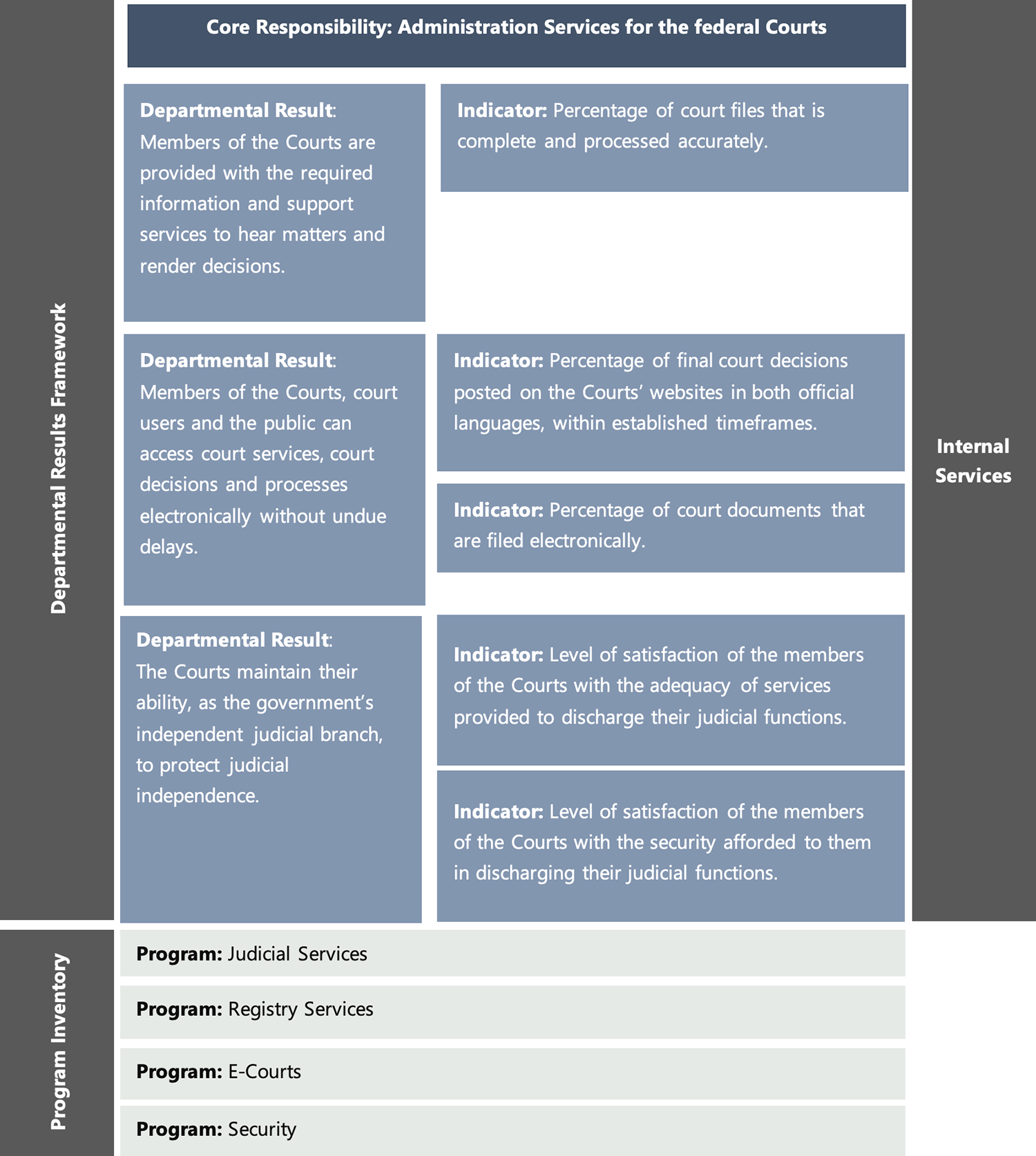
CAS’s approved Departmental Results Framework and Program Inventory for 2020–21 are shown below.
Description of the image
Departmental Results Framework
Core Responsibility: Administration services for the federal courts
Departmental Result: Members of the Courts are provided with the required information and support services to hear matters and render decisions.
- Indicator: Percentage of court files that is complete and processed accurately.
Departmental Result: Members of the Courts, court users and the public can access court services, court decisions and processes electronically without undue delays.
- Indicator: Percentage of final court decisions posted on the Courts’ websites in both official languages, within established timeframes.
- Indicator: Percentage of court documents that are filed electronically.
Departmental Result: The Courts maintain their ability, as the government’s independent judicial branch, to protect judicial independence.
- Indicator: Level of satisfaction of the members of the Courts with the adequacy of services provided to discharge their judicial functions.
- Indicator: Level of satisfaction of the members of the Courts with the security afforded to them in discharging their judicial functions.
Internal Services
Program Inventory
- Program: Judicial Services
- Program: Registry Services
- Program: E-Courts
- Program: Security
Supporting information on the program inventory
Supporting information on planned expenditures, human resources, and results related to CAS’s program inventory is available in the GC InfoBase.Footnote xi
Supplementary information tables
The following supplementary information tables are available on the CAS website.Footnote xii
Organizational contact information
Mailing address
Courts Administration Service
90 Sparks Street
Ottawa, Ontario K1A 0H9
Canada
Email: Info@cas-satj.gc.ca
Website: /en/home
Appendix: definitions
- appropriation (crédit)
- Any authority of Parliament to pay money out of the Consolidated Revenue Fund.
- budgetary expenditures (dépenses budgétaires)
- Operating and capital expenditures; transfer payments to other levels of government, organizations or individuals; and payments to Crown corporations.
- core responsibility (responsabilité essentielle)
- An enduring function or role performed by a department. The intentions of the department with respect to a core responsibility are reflected in one or more related departmental results that the department seeks to contribute to or influence.
- Departmental Plan (plan ministériel)
- A report on the plans and expected performance of an appropriated department over a 3 year period. Departmental Plans are usually tabled in Parliament each spring.
- departmental priority (priorité ministérielle)
- A plan or project that a department has chosen to focus and report on during the planning period. Priorities represent the things that are most important or what must be done first to support the achievement of the desired departmental results.
- departmental result (résultat ministériel)
- A consequence or outcome that a department seeks to achieve. A departmental result is often outside departments’ immediate control, but it should be influenced by program-level outcomes.
- departmental result indicator (indicateur de résultat ministériel)
- A quantitative measure of progress on a departmental result.
- departmental results framework (cadre ministériel des résultats)
- A framework that connects the department’s core responsibilities to its departmental results and departmental result indicators.
- Departmental Results Report (rapport sur les résultats ministériels)
- A report on a department’s actual accomplishments against the plans, priorities and expected results set out in the corresponding Departmental Plan.
- experimentation (expérimentation)
- The conducting of activities that seek to first explore, then test and compare the effects and impacts of policies and interventions in order to inform evidence-based decision-making, and improve outcomes for Canadians, by learning what works, for whom and in what circumstances. Experimentation is related to, but distinct from innovation (the trying of new things), because it involves a rigorous comparison of results. For example, using a new website to communicate with Canadians can be an innovation; systematically testing the new website against existing outreach tools or an old website to see which one leads to more engagement, is experimentation.
- full time equivalent (équivalent temps plein)
- A measure of the extent to which an employee represents a full person year charge against a departmental budget. For a particular position, the full time equivalent figure is the ratio of number of hours the person actually works divided by the standard number of hours set out in the person’s collective agreement.
- gender-based analysis plus (GBA Plus) (analyse comparative entre les sexes plus [ACS Plus])
- An analytical process used to assess how diverse groups of women, men and gender-diverse people experience policies, programs and services based on multiple factors including race ethnicity, religion, age, and mental or physical disability.
- government-wide priorities (priorités pangouvernementales)
- For the purpose of the 2020–21 Departmental Results Report, those high-level themes outlining the government’s agenda in the 2019 Speech from the Throne, namely: Fighting climate change; Strengthening the Middle Class; Walking the road of reconciliation; Keeping Canadians safe and healthy; and Positioning Canada for success in an uncertain world.
- horizontal initiative (initiative horizontale)
- An initiative where two or more federal organizations are given funding to pursue a shared outcome, often linked to a government priority.
- non budgetary expenditures (dépenses non budgétaires)
- Net outlays and receipts related to loans, investments and advances, which change the composition of the financial assets of the Government of Canada.
- performance (rendement)
- What an organization did with its resources to achieve its results, how well those results compare to what the organization intended to achieve, and how well lessons learned have been identified.
- performance indicator (indicateur de rendement)
- A qualitative or quantitative means of measuring an output or outcome, with the intention of gauging the performance of an organization, program, policy or initiative respecting expected results.
- performance reporting (production de rapports sur le rendement)
- The process of communicating evidence based performance information. Performance reporting supports decision making, accountability and transparency.
- plan (plan)
- The articulation of strategic choices, which provides information on how an organization intends to achieve its priorities and associated results. Generally, a plan will explain the logic behind the strategies chosen and tend to focus on actions that lead to the expected result.
- planned spending (dépenses prévues)
- For Departmental Plans and Departmental Results Reports, planned spending refers to those amounts presented in Main Estimates.
A department is expected to be aware of the authorities that it has sought and received. The determination of planned spending is a departmental responsibility, and departments must be able to defend the expenditure and accrual numbers presented in their Departmental Plans and Departmental Results Reports. - program (programme)
- Individual or groups of services, activities or combinations thereof that are managed together within the department and focus on a specific set of outputs, outcomes or service levels.
- program inventory (répertoire des programmes)
- Identifies all the department’s programs and describes how resources are organized to contribute to the department’s core responsibilities and results.
- result (résultat)
- A consequence attributed, in part, to an organization, policy, program or initiative. Results are not within the control of a single organization, policy, program or initiative; instead they are within the area of the organization’s influence.
- statutory expenditures (dépenses législatives)
- Expenditures that Parliament has approved through legislation other than appropriation acts. The legislation sets out the purpose of the expenditures and the terms and conditions under which they may be made.
- target (cible)
- A measurable performance or success level that an organization, program or initiative plans to achieve within a specified time period. Targets can be either quantitative or qualitative.
- voted expenditures (dépenses votées)
- Expenditures that Parliament approves annually through an appropriation act. The vote wording becomes the governing conditions under which these expenditures may be made.
- Date modified: