
Quarterly Financial Report - For the quarter ended September 30, 2024
Statement outlining results, risks and significant changes in operations, personnel and programs
Introduction
This quarterly report should be read in conjunction with the Main Estimates. It has been prepared by management, as required by section 65.1 of the Financial Administration Act and in the form and manner prescribed by Treasury Board. This quarterly report has not been subject to an external audit or review.
The role of the Courts Administration Service (CAS) is to provide administrative services to four superior courts of law: the Federal Court of Appeal, the Federal Court, the Court Martial Appeal Court of Canada and the Tax Court of Canada. Further details on CAS’ programs can be found in the 2024-25 Main Estimates.
Basis of Presentation
This quarterly report has been prepared by management using an expenditure basis of accounting. The accompanying Statement of Authorities includes CAS’ spending authorities granted by Parliament and those used by the organization consistent with the 2024-25 Main Estimates. This quarterly report has been prepared using a prescribed financial reporting framework designed to meet financial information needs with respect to the use of spending authorities.
The authority of Parliament is required before monies can be spent by the Government. Approvals are given in the form of annually approved limits through appropriation acts or legislation in the form of statutory spending authority for specific purposes.
CAS uses the full accrual method of accounting to prepare and present its annual departmental financial statements that are part of the departmental results reporting process. However, the spending authorities voted by Parliament remain on an expenditure basis.
Highlights of fiscal quarter and fiscal year to date (YTD) results
Significant Changes to Authorities available for use for the fiscal year
As illustrated in the Statement of Authorities and the Departmental Budgetary Expenditures by Standard Object tables at the end of this report, yearly authorities available for use as at September 30, 2024 increased by $92,318 thousand (89%) compared to the same quarter in 2023-24, from $104,238 thousand to $196,556 thousand.
The increase in authorities is mainly due to $82,873 thousand in funding received for the National Courts Facilities Modernization Program (phases I and II). It also includes an increase of $7,535 thousand related to the signature of collective agreements, $5,848 thousand to Strengthen Service and Digital Capabilities to Modernize Canada’s Federal Courts, $1,281 thousand increase in operating budget carry-forward and $36 thousand for other various smaller initiatives.
The above increases are partly offset by the decrease of $2,108 thousand in contributions to employee benefit plans, $3,147 thousand decrease in funding to support the creation of new judicial positions that was reprofiled in 2023-24.
In 2024-2025, annual authorities include a significant portion of Special Purpose Allotments funding (SPA)1 of 48% ($93,830 thousand out of a total of $196,556 thousand) compared to 4% ($4,496 thousand out of a total of $104,238 thousand) in 2023-2024. This variance represents an increase of $89,334 thousand in SPA.
As a result of the Government expenditure management cycle and certain conditions imposed by Central Agencies, there are often significant fluctuations by quarter between authorities received and the timing of expenditures realized.
Significant Changes to Expenditures
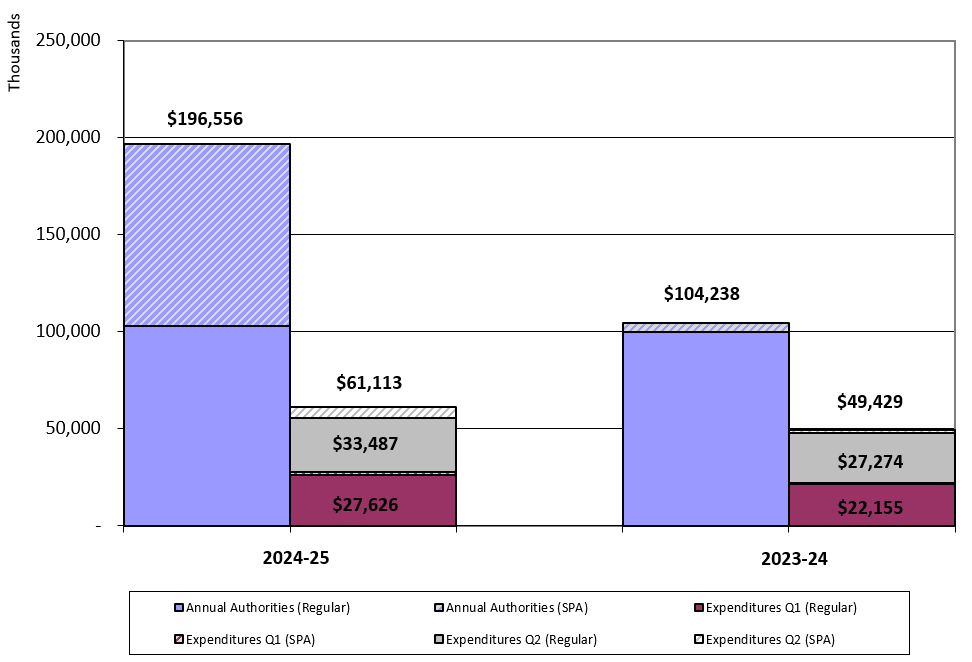
Figure 1 presents current and prior fiscal year expenditures compared to annual authorities at the end of the second quarter. These results are discussed in the section below.
Description of the image
At the end of the second quarter of 2024-25, authorities totalled $196,556 thousand compared to $104,238 thousand at the end of the same quarter of 2023-24.
At the end of the second quarter of 2024-25, expenditures totalled $61,113 thousand compared to $49,429 thousand at the end of the same quarter of 2023-24..
Second-quarter Expenditures
As illustrated in Figure 1, second-quarter expenditures increased by $6,213 thousand (23%) compared to the same period of the previous fiscal year, from $27,274 thousand to $33,487 thousand. As a result, 17% of the yearly authorities available for use were expended during the second quarter of 2024-25, which represent a decrease of 9% compared to the same quarter of 2023-24.
Significant variances2 in expenditures are explained as follows:
Personnel
The year-to-date expenditures related to personnel increased by $7,111 thousand (19%) compared to the same period of the previous fiscal year, from $37,674 thousand to $44,785 thousand. This increase is mainly due to an increase in the number of employees to deliver on the Strengthen Service and Digital Capabilities to Modernize Canada’s Federal Courts (SSDC) and National Courts Facilities Modernization Program (NCFMP) initiatives, as well as higher salaries rates relating to signature of collective agreements in 2023-24.
Transportation and telecommunication
The year-to-date expenditures related to transportation and telecommunication increased by $283 thousand (22%) compared to the same period of the previous fiscal year, from $1,281 thousand to $1,564 thousand. This is mainly due to an increase in postages and travel to support hearings and the NCFMP.
Information
The year-to-date expenditures related to information increased by $351 thousand (126%) compared to the same period of the previous fiscal year, from $278 thousand to $629 thousand. This is mainly due to an increase in electronic subscriptions for the judicial library.
Professional and special services
The year-to-date expenditures related to professional and special services increased by $3,148 thousand (59%) compared to the same period of the previous fiscal year, from $5,320 thousand to $8,468 thousand. This is mainly due to an increase in engineering fees to support the new Montreal Judicial complex and Toronto construction projects, as well as an increase in IT consultants to support the SSDC initiative. Other variances are due to timing variations related to the processing of invoices for translation and protection services between quarters.
Rentals
The year-to-date expenditures related to rentals increased by $457 thousand (15%) compared to the same period of the previous fiscal year, from $3,060 thousand to $3,517 thousand. This increase is due to the timing variations related to the processing of invoices for office buildings rental between quarters.
Acquisition of land, building and works
The year-to-date expenditures related to acquisition of land, building and works increased by $26 thousand compared to the same period of the previous fiscal year, from $0 thousand to $26 thousand. This increase is due to the timing of leasehold improvements for which costs can vary from year to year depending on the stage of each project.
Acquisition of machinery and equipment
The year-to-date expenditures related to acquisition of machinery and equipment increased by $518 thousand (239%) compared to the same period of the previous fiscal year, from $217 thousand to $735 thousand. This is mainly due to an increase in purchase of video and communications equipment for the Toronto construction projects.
Other subsidies and payments
The year-to-date expenditures related to other subsidies and payments decreased by $2 thousand (-67%) compared to the same period of the previous fiscal year, from $3 thousand to $1 thousand. This decrease is considered immaterial in value and is mainly due to various administration charges for services.
Remaining expenditures compared to the same period of the previous fiscal year are considered as immaterial variations (repair and maintenance, and utilities, materials & supplies)
Risks and Uncertainties
CAS is currently facing significant financial risks that cannot be absorbed by the 2024-25 budget. The majority of non-personnel expenses incurred by CAS are non-discretionary costs for services supporting the judicial process, court hearings, and court security. They include translation services, protection services, informatics services, court reporters, transcripts, court ushers and other similar costs. These costs are mostly driven by the volume, type and duration of hearings conducted in any given year, which are non-discretionary and can limit the organization's financial flexibility.
Amendments to the Official Languages Act have come into force in June 2024, requiring CAS to release in both official languages simultaneously decisions of precedential value, in addition to cases that raise questions of law of general public interest or national importance. The impact on CAS’ operations is very significant and resource intensive. CAS does not have the appropriate level of resources to meet these new legislative requirements.
CAS is also experiencing increased costs, case complexity and volume, which reduces CAS's ability to meet its obligations and invest in the new technology needed to optimize our processes and operations. CAS continues to address the risks associated with financial inflexibility by implementing a variety of mitigation strategies, including the establishment of baseline and multi-year budgets; reorganization and realignment of services, reallocation of resources, regular reassessment of priorities; exploring alternative funding models and finding efficiencies However, in the short term, all these efforts will not produce sufficient results to close the budget gap.
Through different reviews and consultations, a lack of digital maturity within the organization has been identified. The potential risk with that low level of maturity will be addressed by investing in CAS digital foundations. CAS has started by increasing internal capacity within the digital transformation team.
Significant changes in relation to operations, personnel and programs
There has been a change to the executive management team since July 1, 2024:
- Christos Bakalakis was appointed on September 3, 2024 as Regional Director General, Toronto region.
Approval by Senior Officials
Approved by:
Original signed by
Darlene H. Carreau, LL.B
Chief Administrator
and Chief Executive Officer
Original signed by
Jean-Francois Talbot,
Assistant Deputy Minister,
Corporate Services and
Chief Financial Officer
(Ottawa, Canada)
(November 29, 2024)
| Fiscal year 2024-25 | Fiscal year 2023-24 | |||||
|---|---|---|---|---|---|---|
| Total available for use for the year ending March 31, 20253 | Used during the quarter ended September 30, 2024 | Year-to-date used at quarter-end | Total available for use for the year ending March 31, 20243 | Used during the quarter ended September 30, 2023 | Year-to-date used at quarter-end | |
| Vote 1 – Operating expenditures | $186,361 | $30,911 | $56,016 | $95,454 | $25,078 | $44,037 |
| Statutory authorities: | ||||||
| Contributions to employee benefit plans | 10,195 | 2,576 | 5,097 | 8,784 | 2,196 | 4,392 |
| Spending of proceeds from the disposal of surplus Crown assets | - | - | - | - | - | - |
| Refunds of amounts credited to revenues in previous years | - | - | - | - | - | - |
| Total budgetary authorities | $196,556 | $33,487 | $61,113 | $104,238 | $27,274 | $49,249 |
| Expenditures: | Fiscal year 2024-25 | Fiscal year 2023-24 | ||||
|---|---|---|---|---|---|---|
| Planned expenditures for the year ending March 31, 2025 | Expended during the quarter ended September 30, 2024 | Year-to-date used at quarter-end | Planned expenditures for the year ending March 31, 2024 | Expended during the quarter ended September 30, 2023 | Year-to-date used at quarter-end | |
| Personnel | $85,215 | $23,769 | $44,785 | $66,573 | $20,052 | $37,674 |
| Transportation and communications | 3,183 | 846 | 1,564 | 3,308 | 798 | 1,281 |
| Information | 528 | 356 | 629 | 967 | 24 | 278 |
| Professional and special services | 59,487 | 5,264 | 8,468 | 16,531 | 3,672 | 5,320 |
| Rentals | 6,082 | 2,115 | 3,517 | 5,163 | 1,792 | 3,060 |
| Repair and maintenance | 641 | 76 | 195 | 644 | 107 | 220 |
| Utilities, materials and supplies | 2,729 | 470 | 1,193 | 3,059 | 641 | 1,376 |
| Acquisition of land, building and works | 27,123 | 26 | 26 | 3,426 | - | - |
| Acquisition of machinery and equipment | 11,546 | 564 | 735 | 4,567 | 185 | 217 |
| Other subsidies and payments | 22 | 1 | 1 | - | 3 | 3 |
| Total budgetary expenditures | $196,556 | $33,487 | $61,113 | $104,238 | $27,274 | $49,429 |
Groupings can change between quarters due to materiality of initiatives.
Amounts may not balance with other public documents due to rounding..
1 Special purpose allotments (SPA) are used to restrict the use of funds to specific programs or initiatives.
2 Significant variances are defined as variances by standard object that are greater than $250 thousand or 25%.
3 - Includes only authorities available for use and granted by Parliament at quarter-end.
- Date modified: